
Heyo, Ilya here 👋
We just finished the biggest piece of cold email deliverability research I have ever seen anyone do. Including us.
450,000 test emails. 27 weekly runs. Around 4,000 mailboxes, tested every single Monday for five months.
Not a survey. Not somebody's opinion. Our own sending, measured.
We placement-test every mailbox we run, every single week. That is where these numbers come from, and it is also why we can tell you what is wrong with yours.
No time to read all of it? Start here.
If you are building outbound from scratch, or running it now and you suspect deliverability might be why your numbers are soft, do not guess at it.
Book a short call and we will audit what you actually have. We go through your current setup, run inbox placement tests across your mailboxes and domains, and tell you straight whether deliverability is your problem or whether it is something else.
You walk away with the exact checklist of what to fix and the order to fix it in. Use it yourself, or have us do it.
Book a quick deliverability audit
Below are the seven things that actually matter. Short, because you have a job.
1. Spam is a domain problem, not a mailbox problem
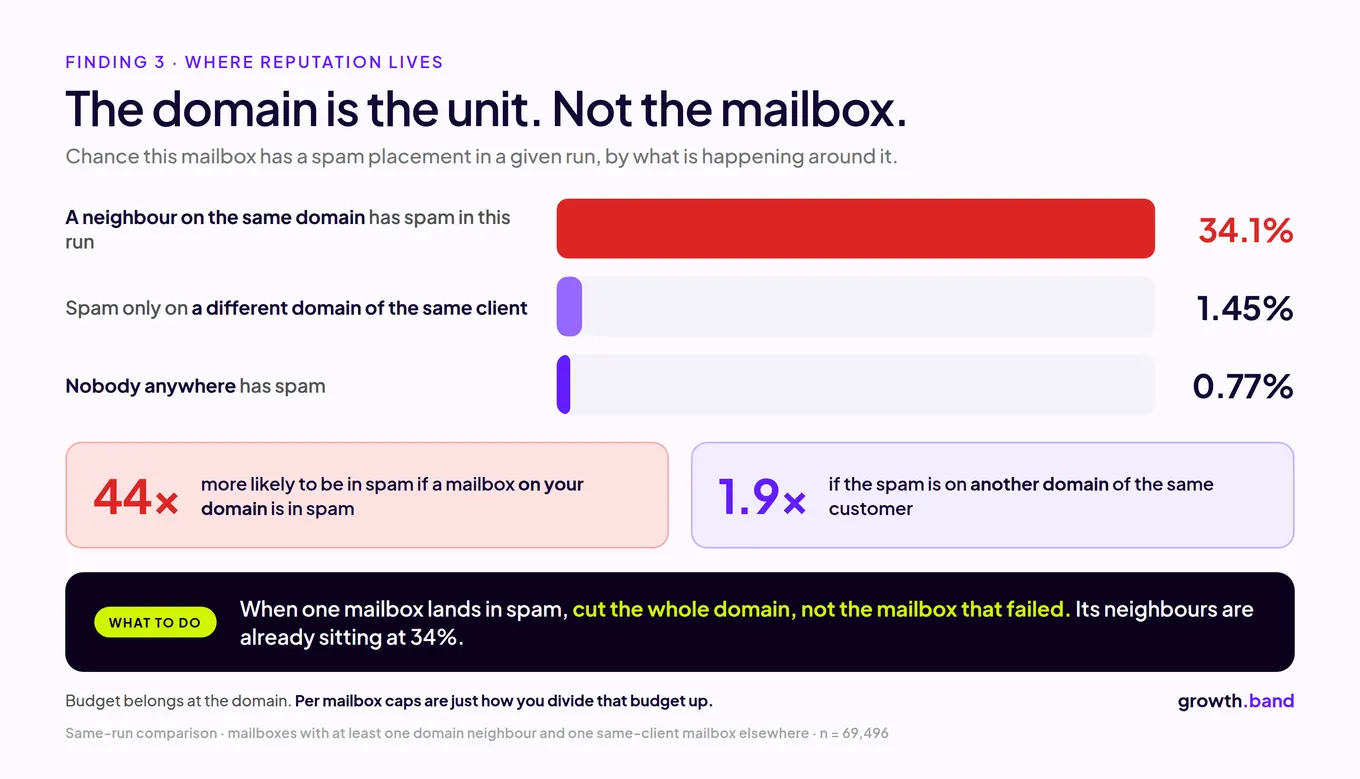
One mailbox starts landing in spam. You pause it, and you move on.
Its neighbours on the same domain have a 34% chance of the same problem. Mailboxes on your other domains: 1.45%. It does not travel between domains. It spreads inside one.
✅ Kill the whole domain, not the mailbox. And build wide, not deep. More domains with a few mailboxes each, never more mailboxes stacked onto one domain.
2. Warm-up length decides the rest of that mailbox's life
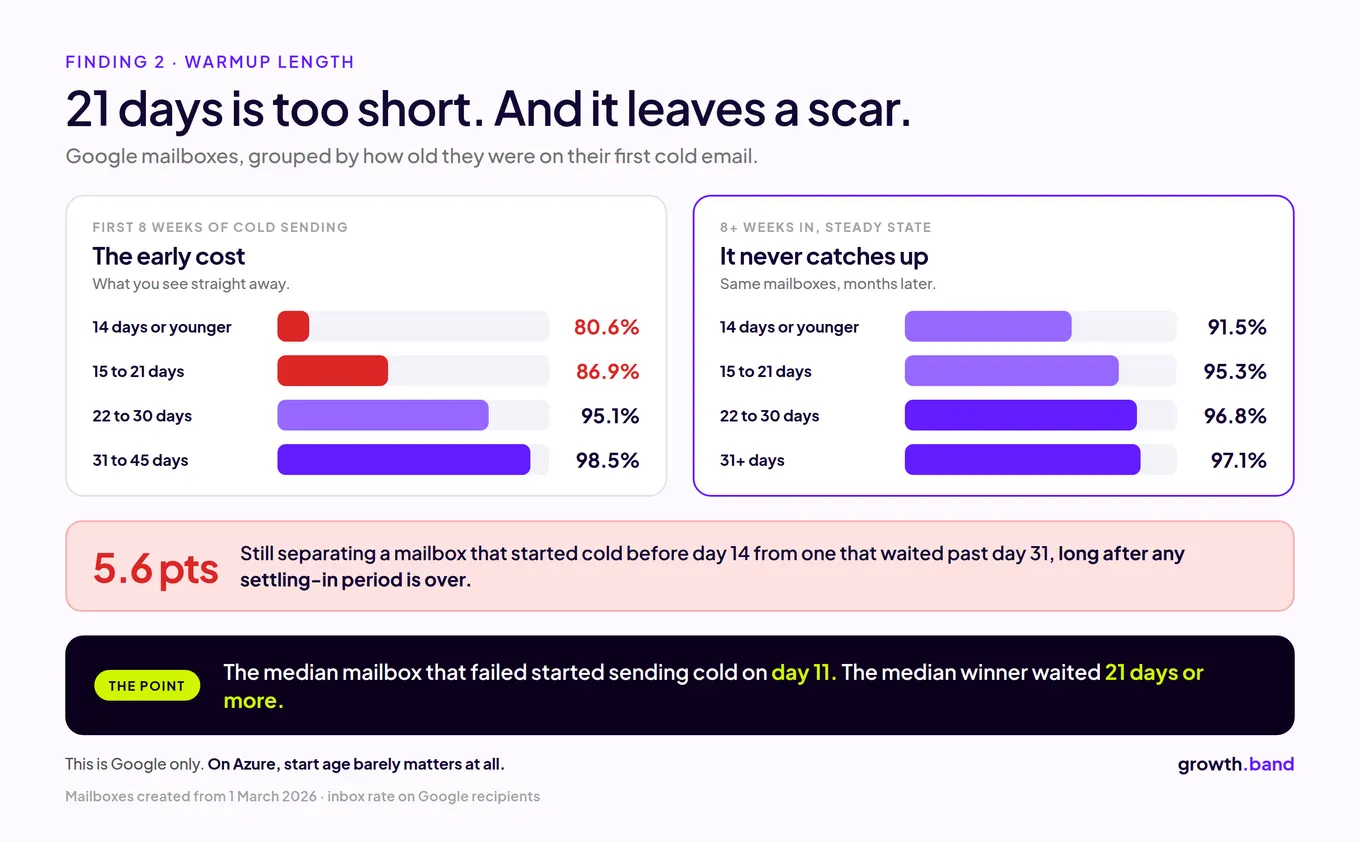
Everyone warms up for 21 days and then starts sending. That is too early, and the cost is permanent.
Started cold at 14 days: 91.5% inbox rate. Started after 30 days: 97.1%. That is the same mailboxes, months later. It never catches up.
The median mailbox that ended up failing started sending on day 11.
✅ 21 days is survival. 30 days is winning. This is Google. Azure does not care.
3. You can see it coming two weeks early
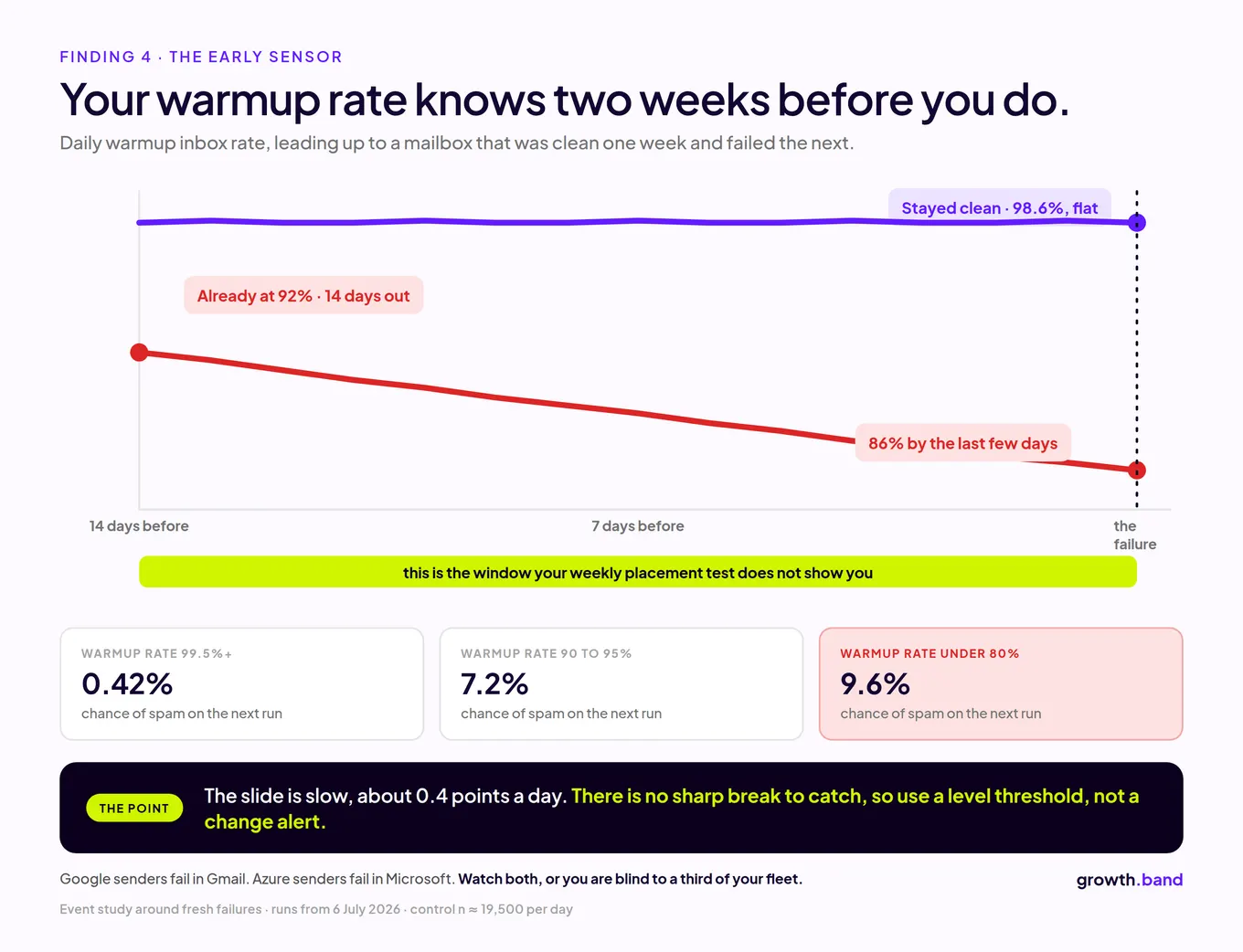
A mailbox about to fail does not fail suddenly. It slides.
Healthy mailboxes sit at 98.6% warm-up inbox rate. Mailboxes two weeks away from failing are already at 92%. Both look green in your tool. That is the whole problem.
And your Google warm-up numbers tell you nothing about your Microsoft mailboxes. Different filter, different failure, separate sensor.
✅ Watch warm-up inbox rate, not your weekly placement test. Below 99.5%, start cutting volume. The placement test only confirms something that started a fortnight ago.
4. There is no safe sending volume
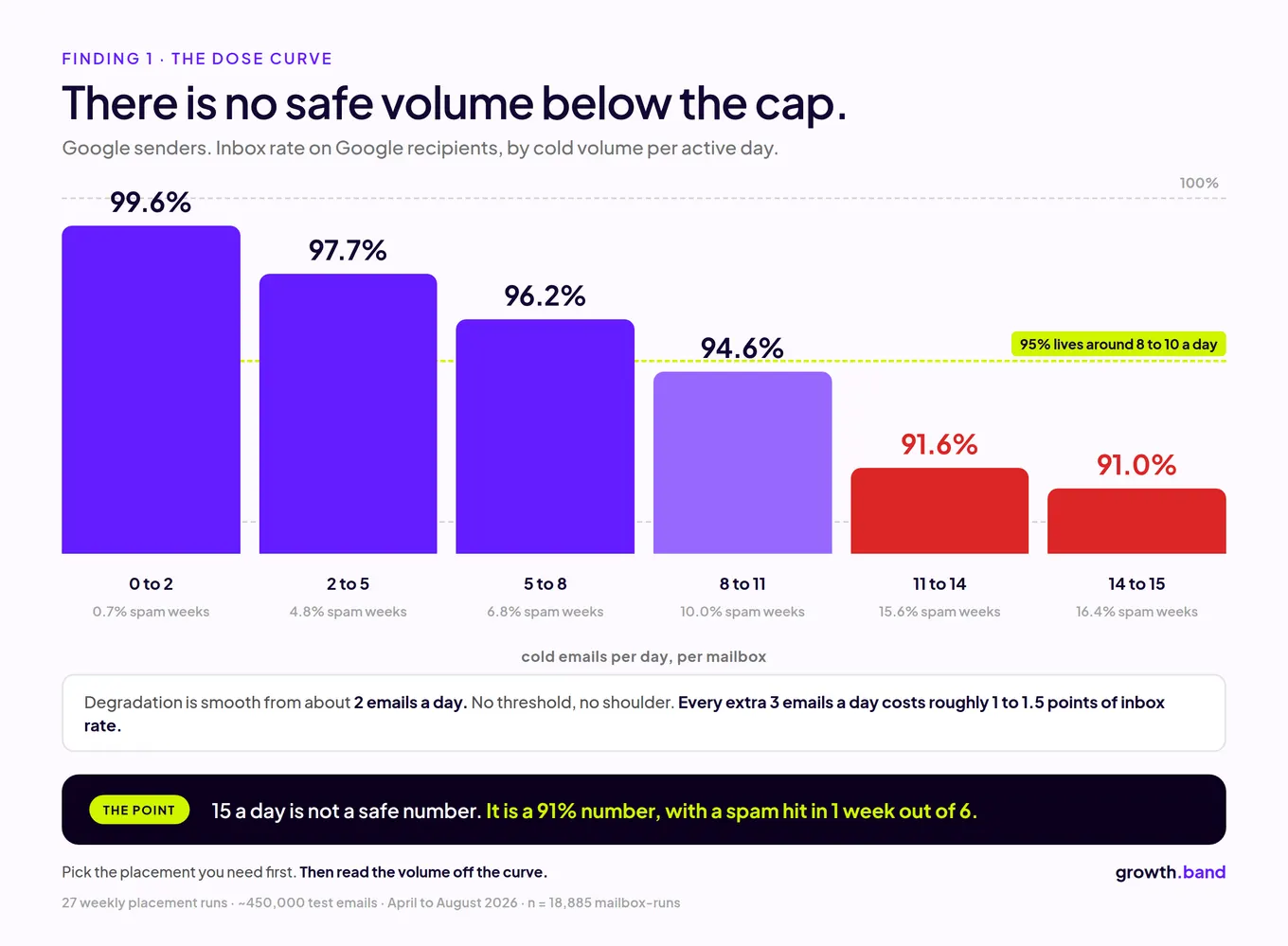
There is no magic number where you are suddenly fine. You pay for every extra email.
5 a day: 97.7% inbox. 10 a day: 94.6%. 15 a day: 91%. Smooth all the way down, starting from about 2 emails a day.
✅ Pick the inbox rate you want, then set the cap. 95% lives around 8 to 10 a day. If you are sending 15, you have chosen 91%, whether you meant to or not.
5. Your dashboard is a week or two behind you
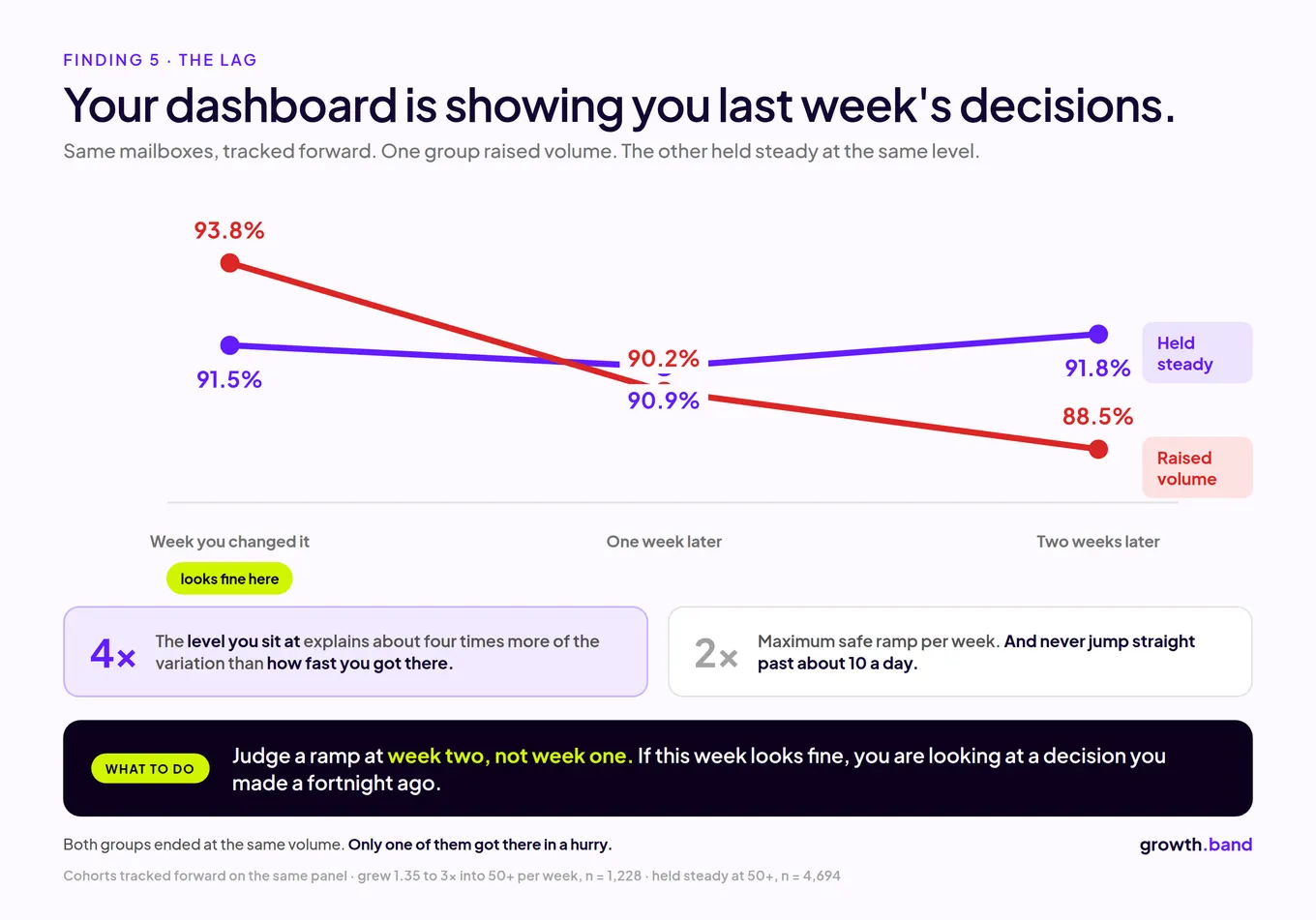
You raise volume. The week looks fine. So you raise it again.
The damage lands one to two weeks later. Mailboxes that jumped to a higher level looked healthy at 93.8%, then fell to 88.5% two weeks on. Mailboxes already sitting at that level stayed flat.
Where you end up matters about four times more than how fast you got there.
✅ Ramp 2x a week, maximum. Then judge it two weeks later, not the same week.
6. When it breaks, cut to half and wait
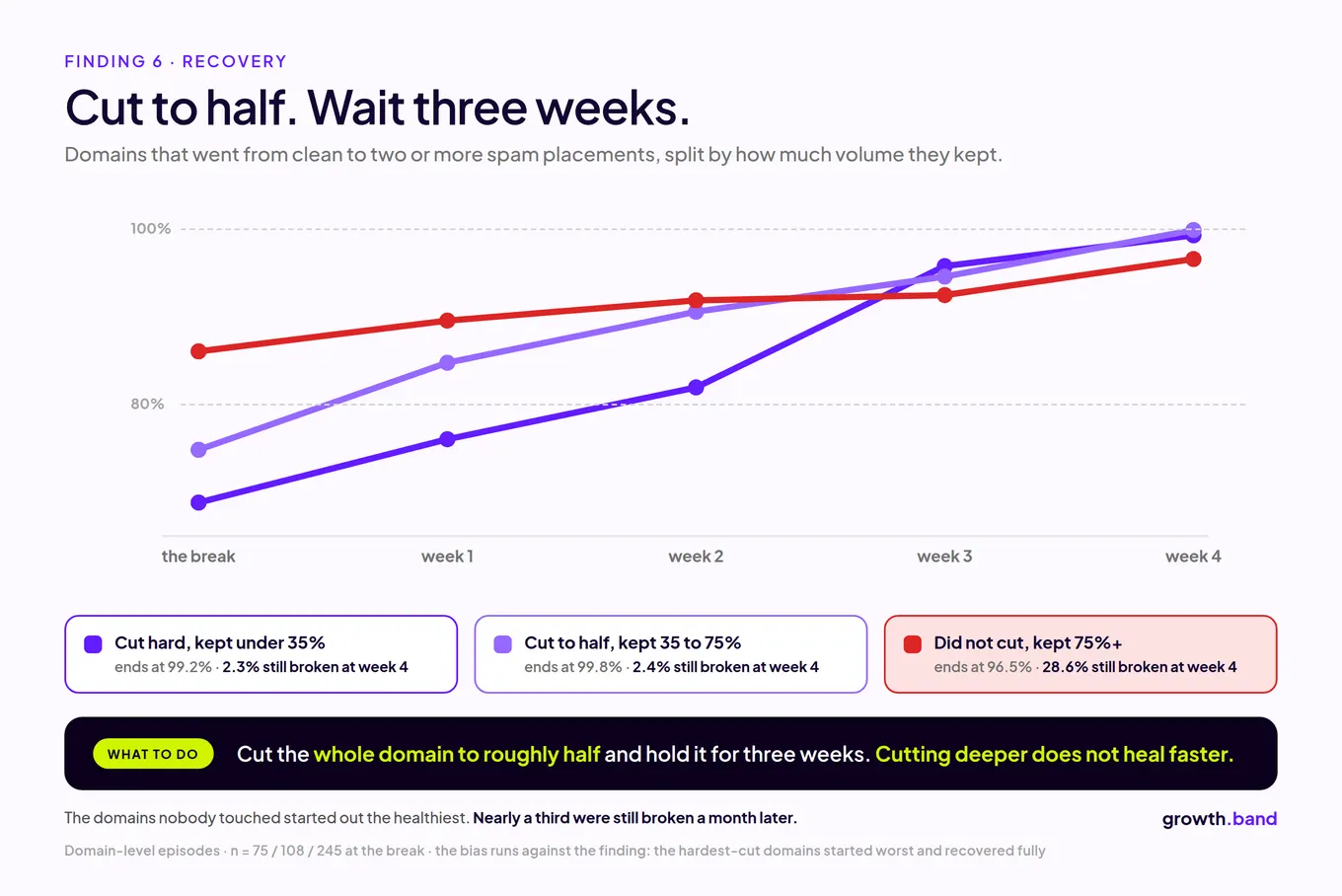
Most people either panic and kill everything, or do nothing and hope.
Cut the domain to half and it heals in about three weeks. Cut harder and it is not any faster. Do not cut at all and 29% of domains are still broken a month later.
Recovery looks flat for two weeks before it jumps, which is exactly when people give up and turn the volume back on.
✅ Half the domain, three weeks, hands off. Panic does not speed it up.
7. The pause is not the problem. The comeback is.
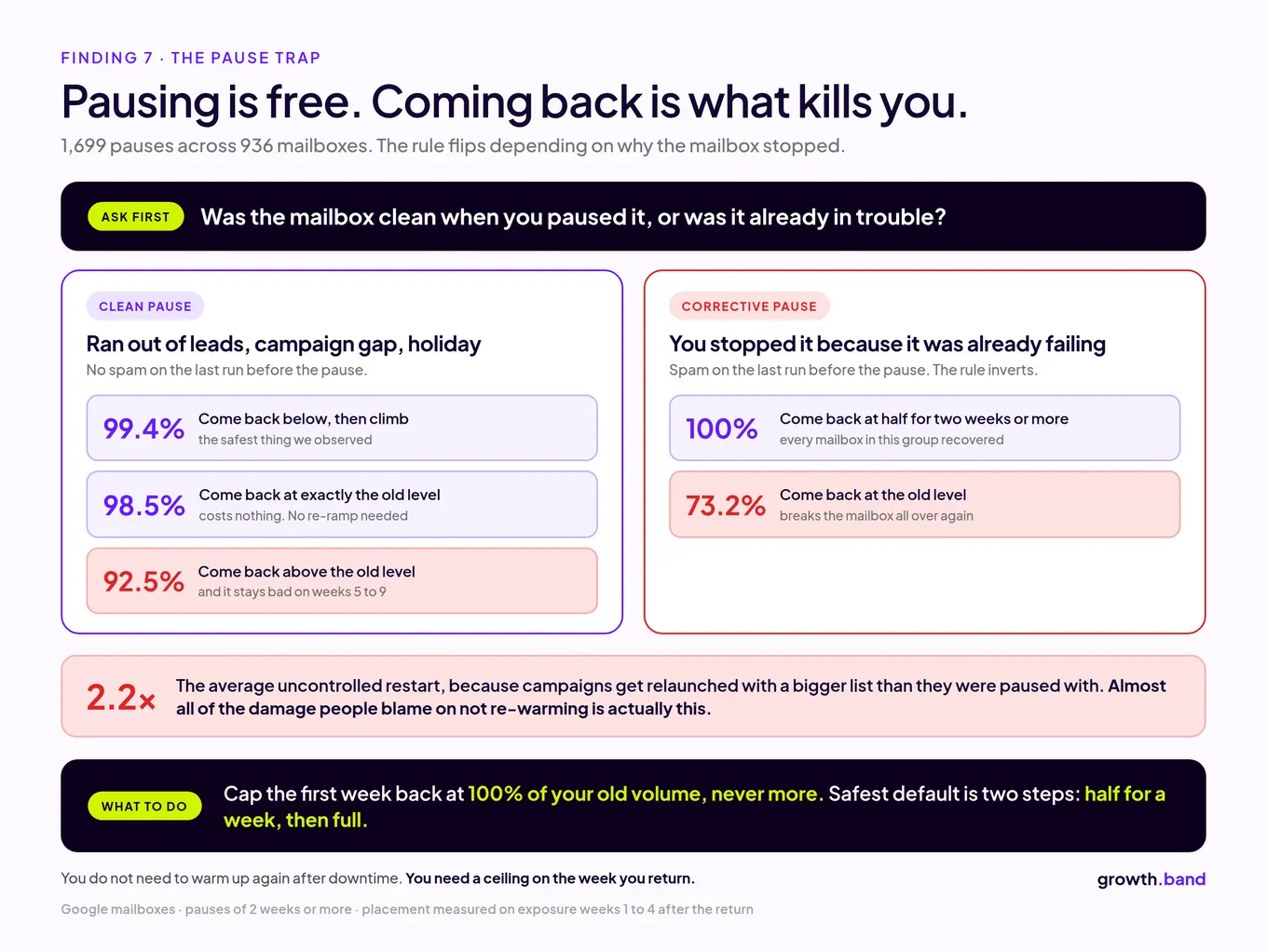
A mailbox does not need to be warmed up again after downtime. That one is a myth.
Come back at your old volume and there is no damage at all. Come back above it and you lose 6 to 7 points, permanently. The average restart is 2.2 times the old level, because campaigns get relaunched with a bigger list than they were paused with.
And if the mailbox was already in trouble before the pause, going straight back to full speed gives you 73% inbox. Coming back gently gives you 100%.
✅ Two steps, always. Half for a week, then full. Never above where you were.
The good news
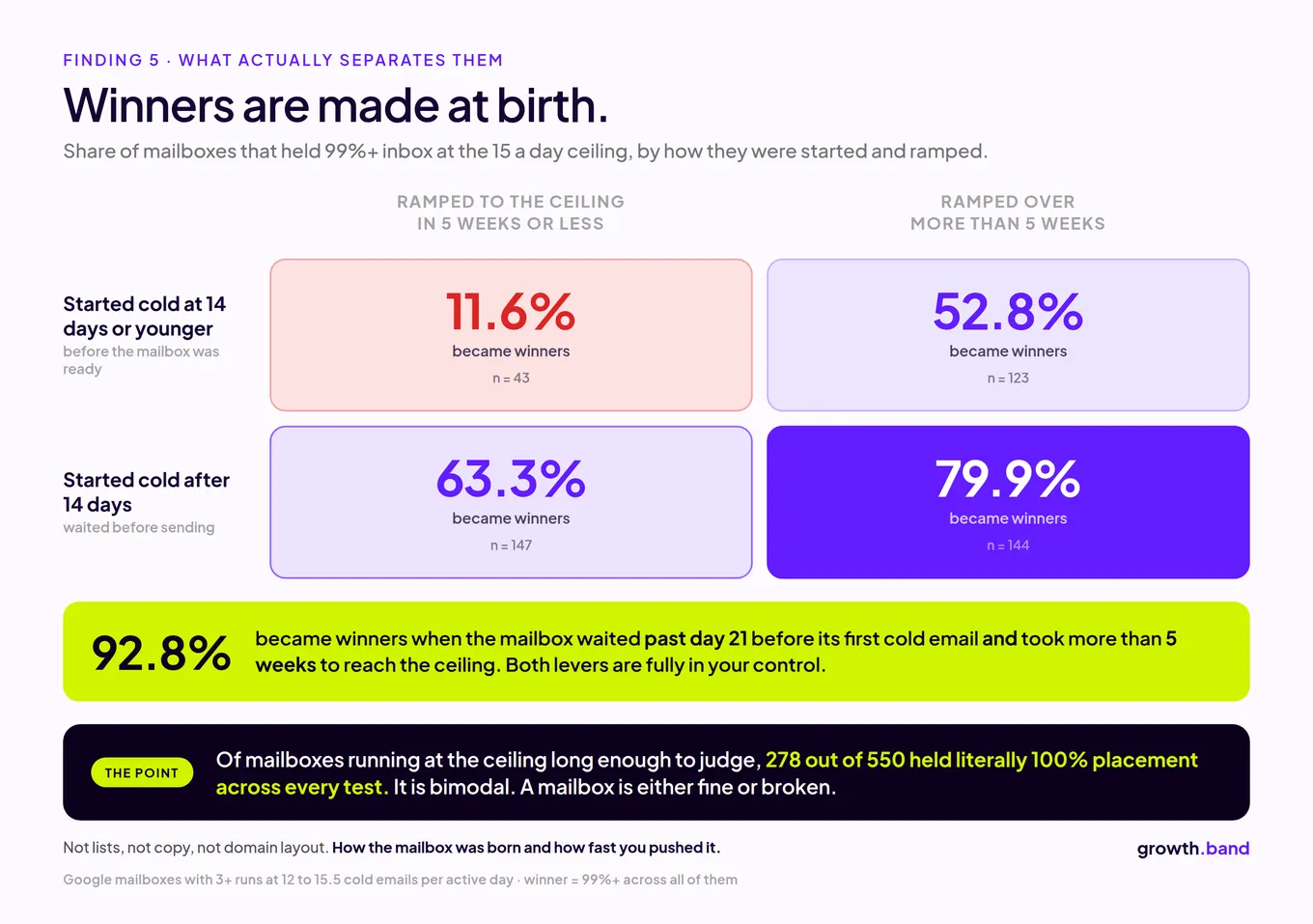
278 out of 550 of our mailboxes running at the ceiling held 100% placement. Every test, for months.
Not 99% on average. Perfect.
That is not luck and it is not a better list. It is how the mailbox was born and how fast it was pushed, and both of those are things we control on every mailbox we run.
It is also why we test the whole fleet weekly, instead of finding out something is wrong when a client's replies stop.
Do you actually know what your deliverability is doing right now?
Most teams find out when the replies stop. By then it has been broken for a month.
We can run the same audit on your setup that produced this research. Every mailbox tested for placement across Google and Microsoft, domain by domain, plus the warm-up numbers your tool is not showing you.
You get back a plain list: what is broken, what is about to break, and the order to fix it in.
Book a quick deliverability audit
Ilya
Get sending infrastructure that stays out of spam
We build and run your cold email infrastructure: domains, mailboxes, daily placement checks and a rotation pool.

Ilya AzovtsevCo-founder
Co-founder of GrowthBand. Helped scale lemlist from $20k MRR to $10M ARR and built automation at Expandi; now runs the cold email infrastructure behind 32,000+ mailboxes.