Hey, Ilya here 👋
Everyone implemented AI in outbound this year. Almost nobody got a better result from it.
We found the reason, and it is not the model. It comes down to one simple thing: "AI used for speed makes bad work faster."
Your email takes 30 seconds now instead of 20 minutes. Your buyer gets the same email they got last year. They can tell.
This issue is the long version of my post from last week: the three levels, the mechanism behind the third one, one scenario, and three things you can do this week without buying anything.
Three ways to write a cold email with AI
Level 1. One chat, one pass.
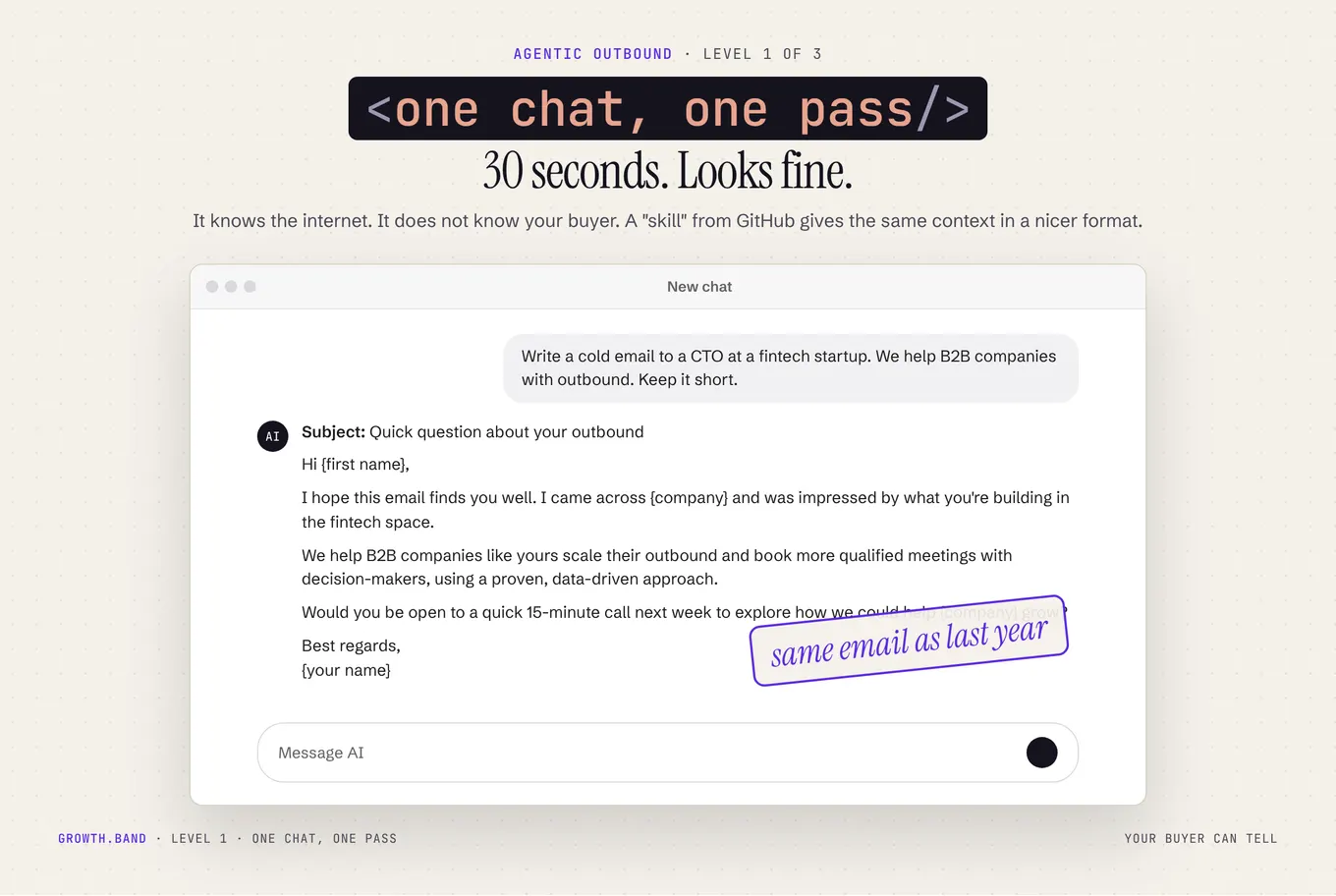
You ask Claude or GPT for an email. 30 seconds, looks fine. You poke at it, it gets a bit better, you are done in 5 minutes.
What it cannot know: your buyer. It knows the internet. A "skill" from GitHub does not fix this. Same context, nicer format.
What the output reads like: a polite stranger who read your website once.
Level 2. A loop.
One agent writes. One scores the draft against a benchmark. One rewrites. Five rounds instead of one, and none of the minutes are yours.
What it cannot know: anything outside the brief you gave it. It iterates on a document, not on your company.
What the output reads like: a well-edited template. Tighter, still generic.
Level 3. A system.
A writing framework, plus research on every single contact, plus your company's context. Not a PDF you uploaded once. The live thing: every sales call recorded and read, every objection logged, every reply remembered.
Time: the setup takes weeks, not minutes. After that, every contact gets their own sequence and nobody types.
What it cannot know: less every week. Each call adds to it.
What the output reads like: the email says the problem the way your buyers said it on the call. That is a different email, not a faster one.
Same story with Clay or Apollo. Faster filters, faster exports. The list is not better.
The mechanism: three blocks
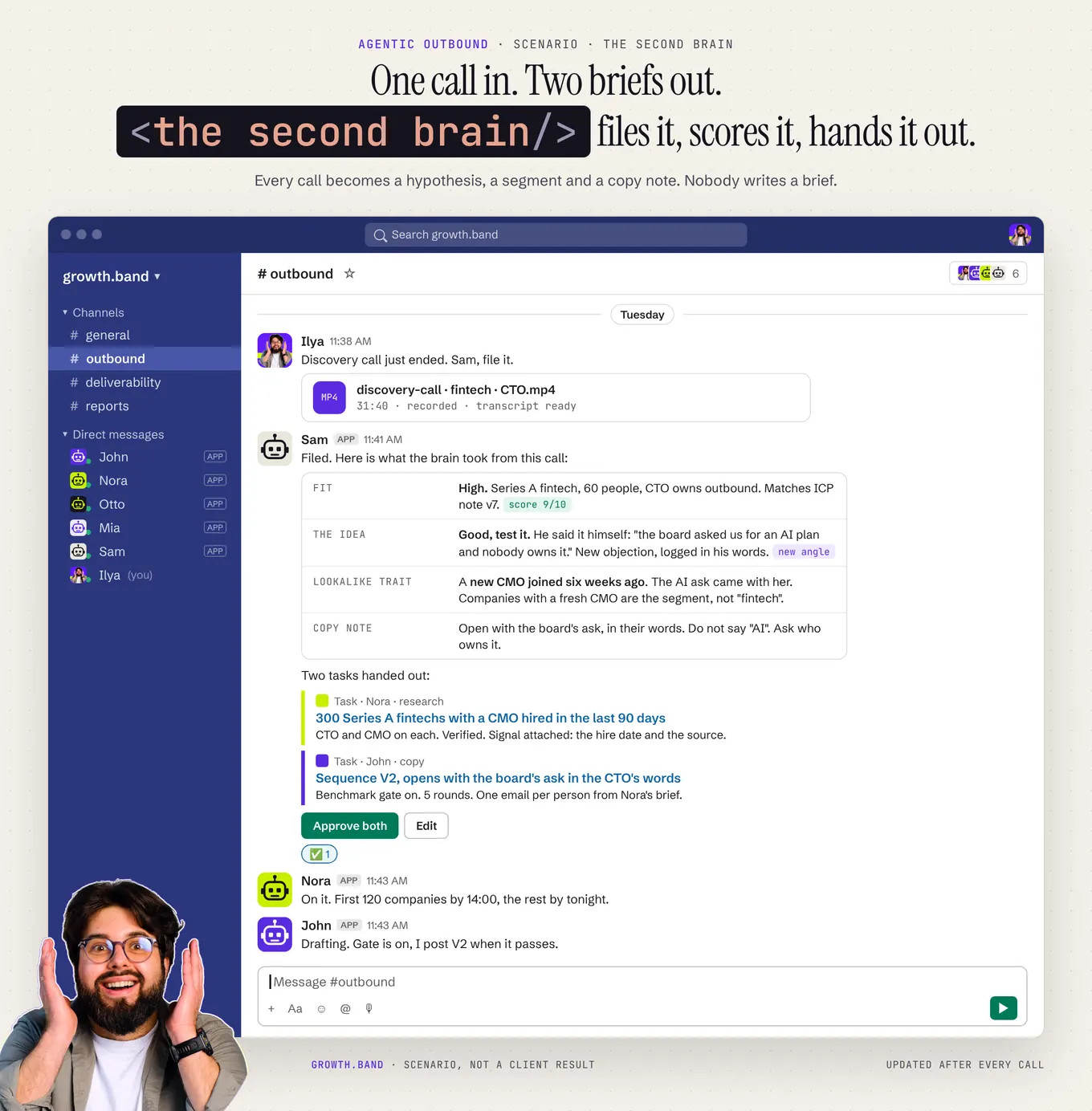
01. The Second Brain. Inputs: call recordings, Slack, email threads, HubSpot, docs and decks, campaign results. Output: ICP, objections, offer, the words buyers actually use. Updated after every call, not once a quarter.
02. Deep research, per contact. LinkedIn profile, posts and comments, company site, hiring and news, Exa search. Output: one brief per person. What they do, what changed, why now.
03. The writing framework. Writer, scorer, rewriter, benchmark gate, human decides. Five rounds, not one. Output: one unique sequence per contact, inside the benchmarks. A template with a first name does not pass the gate.
Block 01 is the one everyone skips, and it is the one doing the work. Run 02 and 03 without it and you have level 2 with more steps.
One scenario: a call becomes a campaign
This is how it runs on our side. It is a scenario, not a client result.
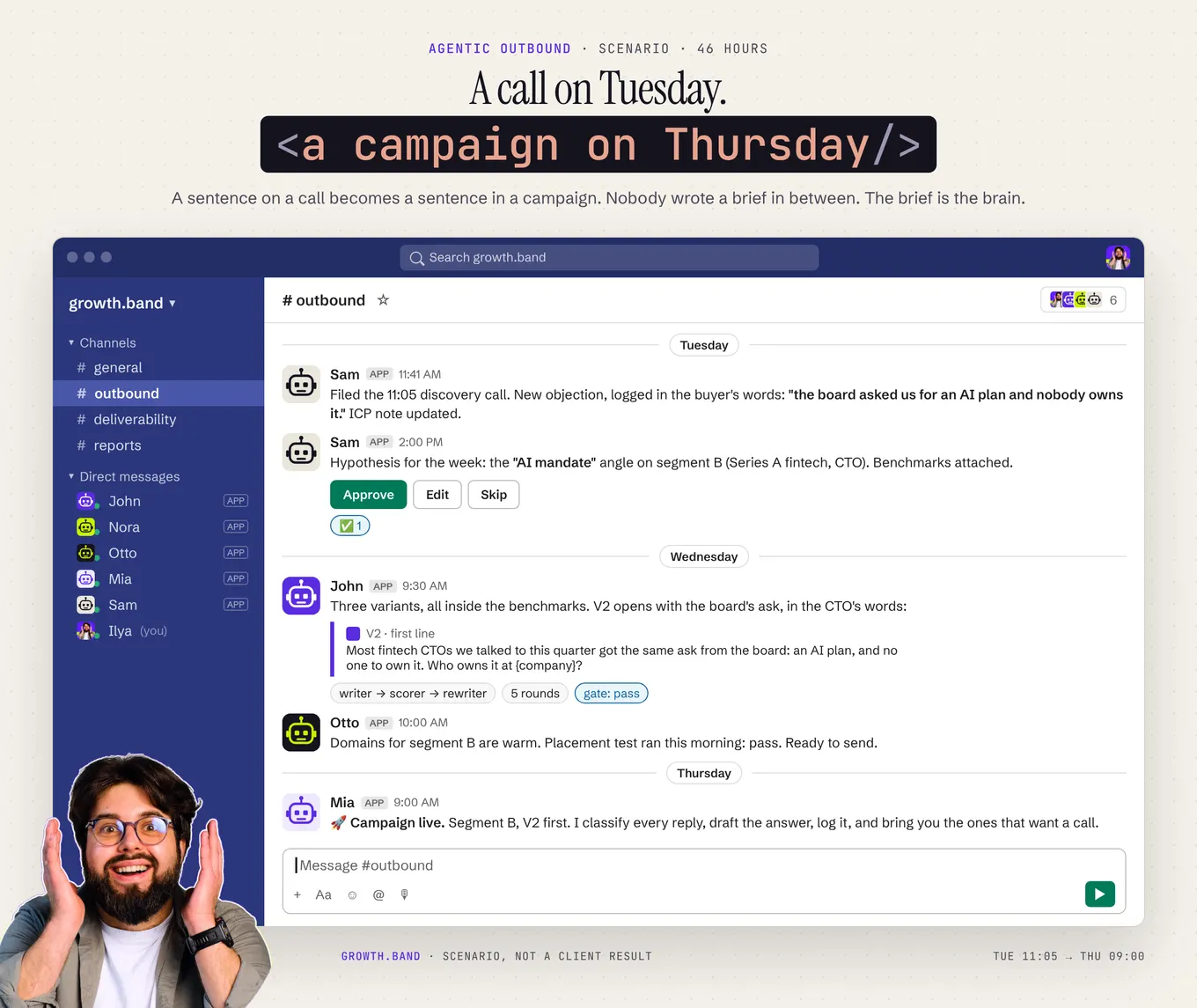
→ Tue 11:05, discovery call. The prospect says: "the board asked us for an AI plan and nobody owns it."
→ Tue 11:40, the brain files it: new objection logged, ICP note updated.
→ Tue 14:00, hypothesis agent: test the "AI mandate" angle on segment B.
→ Wed 09:30, copy agent: three variants, all inside the benchmarks.
→ Wed 10:00, deliverability agent: domains ready, placement tested.
→ Thu 09:00, campaign live. Reply agent watching.
The call line, Tuesday: "the board asked us for an AI plan and nobody owns it."
The email line, Thursday: the first sentence names the board's ask, in those words, and asks who owns it at their company. No "I hope this finds you well". No paragraph about us.
46 hours from a sentence on a call to that sentence in a campaign. Nobody wrote a brief in between. The brief is the brain.
What this did to one campaign
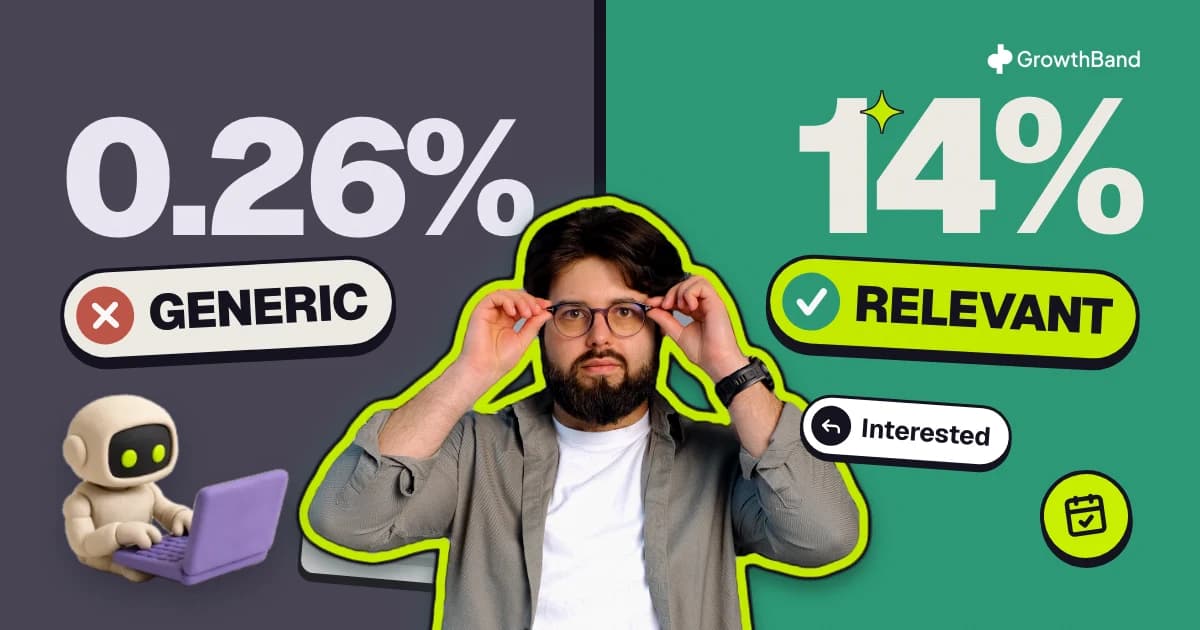
Same offer, four rewrites.
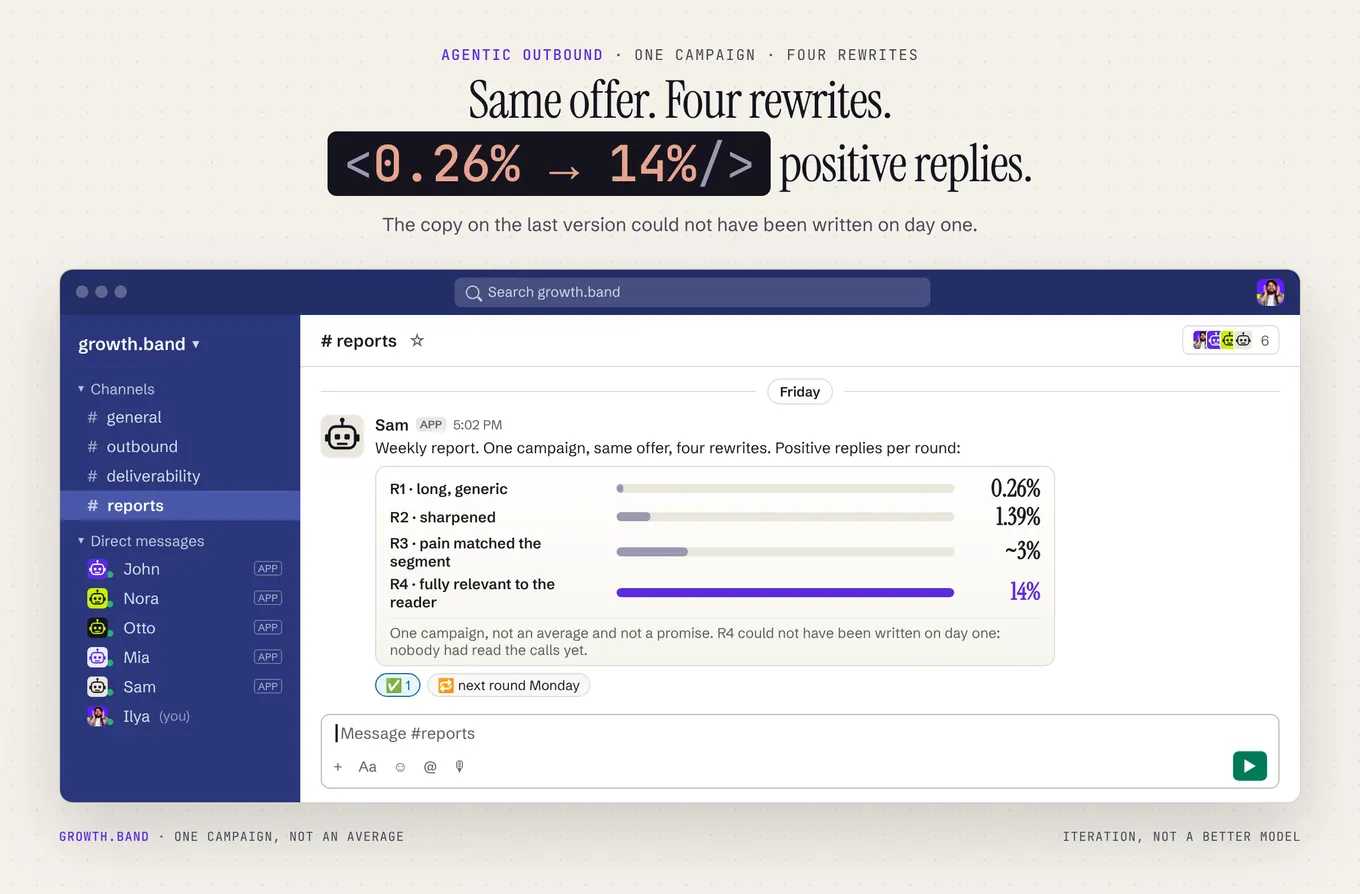
→ 0.26% positive replies on the long, generic version.
→ 1.39% after sharpening.
→ About 3% once the pain matched the segment.
→ 14% when the email was fully relevant to the person reading it.
One campaign. Not an average and not a promise. The last version could not have been written on day one, because on day one nobody had read the calls yet.
The part people don't like
If your plan is "use AI to do the same work faster", you will lose.
Not to a competitor with a better model. To one whose agents sit inside the company, read everything, and decide on it.
That applies to copy. It applies to lists, replies, CRM, reporting. Every process.
So, no: the answer is not "prompt better". The answer is: build the agents. On your context. Inside your process.
This week, with no new tool
Three steps. Block 01, done by hand.
→ Record and transcribe every sales call into one place. One folder is enough. The point is that it exists and every call lands there.
→ Write down the 10 objections you heard this month, in the buyer's words. Not "price concerns". The sentence they actually said.
→ Take your best cold email and rewrite it once using only those words. Send it next to the current version and read both replies.
Everything we build starts from exactly this. The agents come after.
Ilya
Put an outbound team of AI agents in your Slack
Strategy, research, copy and deliverability agents working on your company's context, built and run with you.

Ilya AzovtsevCo-founder
Co-founder of GrowthBand. Helped scale lemlist from $20k MRR to $10M ARR and built automation at Expandi; now runs the cold email infrastructure behind 32,000+ mailboxes.