
Most posts about GTM engineering are written by people who want to hire one.
This one is written from the other side. We run this work every day, for our own outbound and for clients.
So here is the short answer.
A GTM engineer doesn't send emails. They build the system that sends them.
They build loops, not campaigns. And the test of a good one is simple: how much keeps running when they are on holiday.
Below is what that system looks like in our team, part by part. What gets built, what a week looks like, which skills matter and how to start.
Key takeaways
- A GTM engineer is a technical operator who builds the revenue system: the memory, the agents, the checks and the loops. Not the emails.
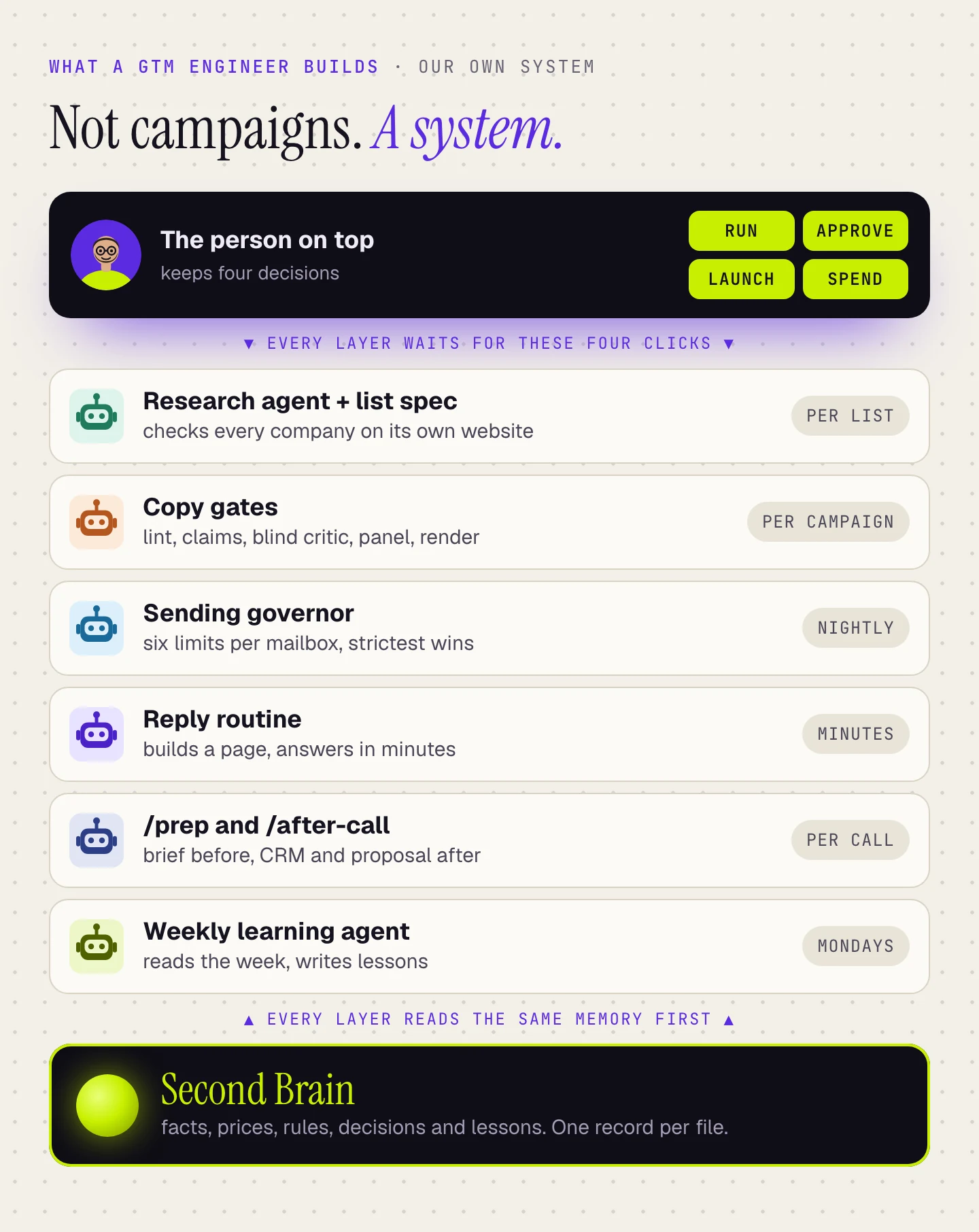
- In our team that system has seven parts: a shared Second Brain, research, copy gates, a sending governor, replies, sales prep and a weekly learning agent.
- The work is mostly turning breaks into rules: every mistake becomes a written rule, and the dangerous ones are enforced in code.
- People keep four decisions: which test runs, the copy, the launch and any spend. Everything else runs inside those gates.
- You can hire one, or start with a team that already runs the system next to yours and keep everything it builds.
What is GTM engineering?
GTM engineering is building your go-to-market as a system instead of staffing it as a set of jobs.
The usual definition: a GTM engineer is a technical operator who builds, automates and scales revenue systems. True. But that sentence fits a Zapier freelancer and a head of RevOps at the same time.
Here is the sharper version, from what the job looks like in practice:
- They own the system, not the accounts. An SDR works a list. A GTM engineer builds what picks the list, writes to it and learns from it.
- They ship rules, agents and checks. Not dashboards. Not slide decks.
- They measure themselves by what runs without them. If the pipeline stops when they log off, the job isn't done.
The strategy, the offer and the sales call stay with the business. The GTM engineer owns the machinery around them.
What a GTM engineer replaces
In 2021 every part of outbound was a person. A researcher built lists. A copywriter wrote. SDRs sent. RevOps kept the CRM. An AE ran the call.
Every handoff between them lost context. The researcher knew why a company was on the list. The SDR who emailed it didn't. The AE who got the call knew neither.
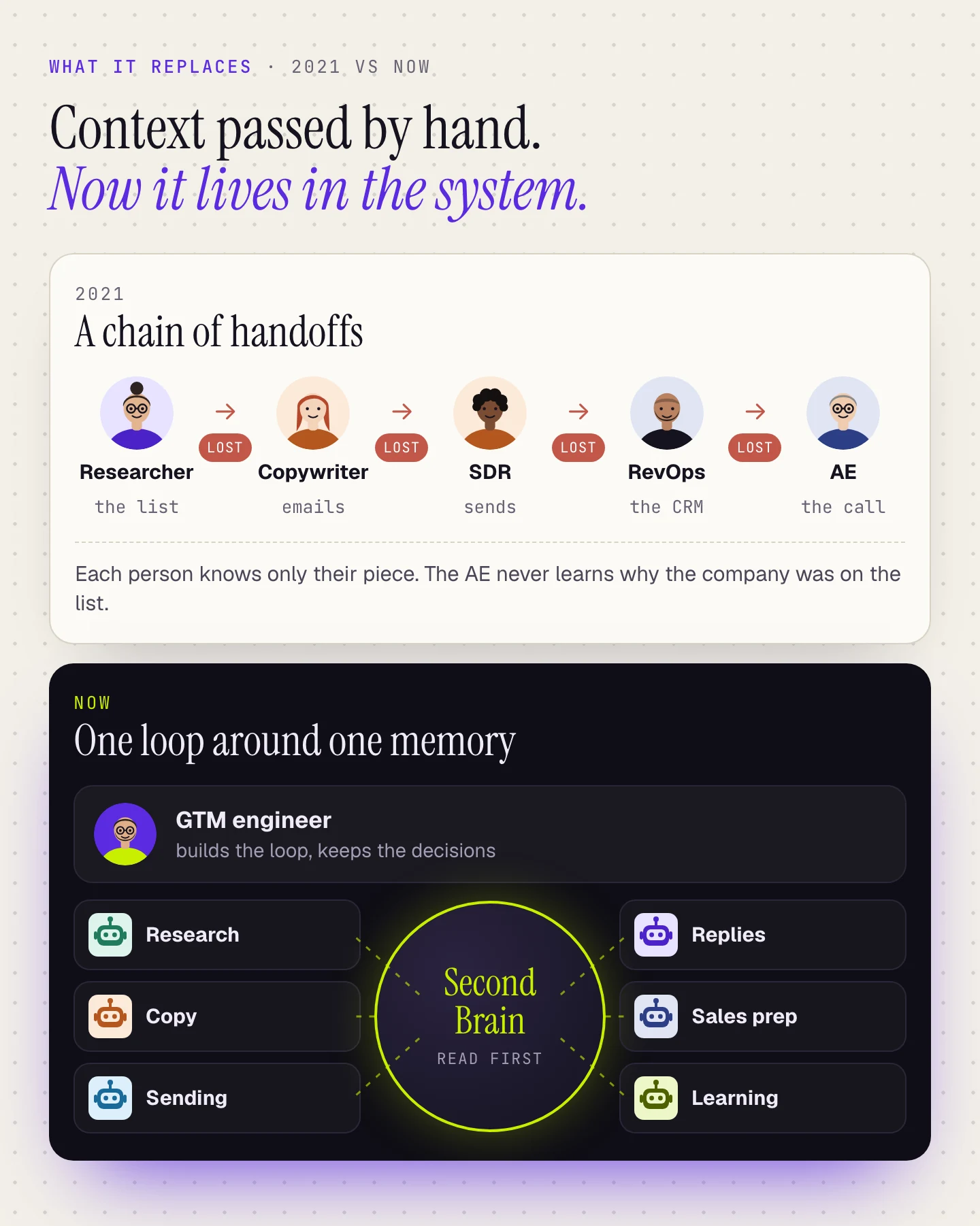
We ran into exactly this problem in our own team. When we audited our setup in late October, rules lived in too many places and we had live contradictions in prices and public numbers. The knowledge existed. It just never reached the next campaign.
A GTM engineer's first job is to fix that: one place for the memory, read by every agent and every person before they work.
GTM engineer vs SDR vs RevOps
The roles overlap on paper, so the easiest way to see the difference is to ask four questions. What do they work on? What do they ship? How are they measured? And what happens when they leave?
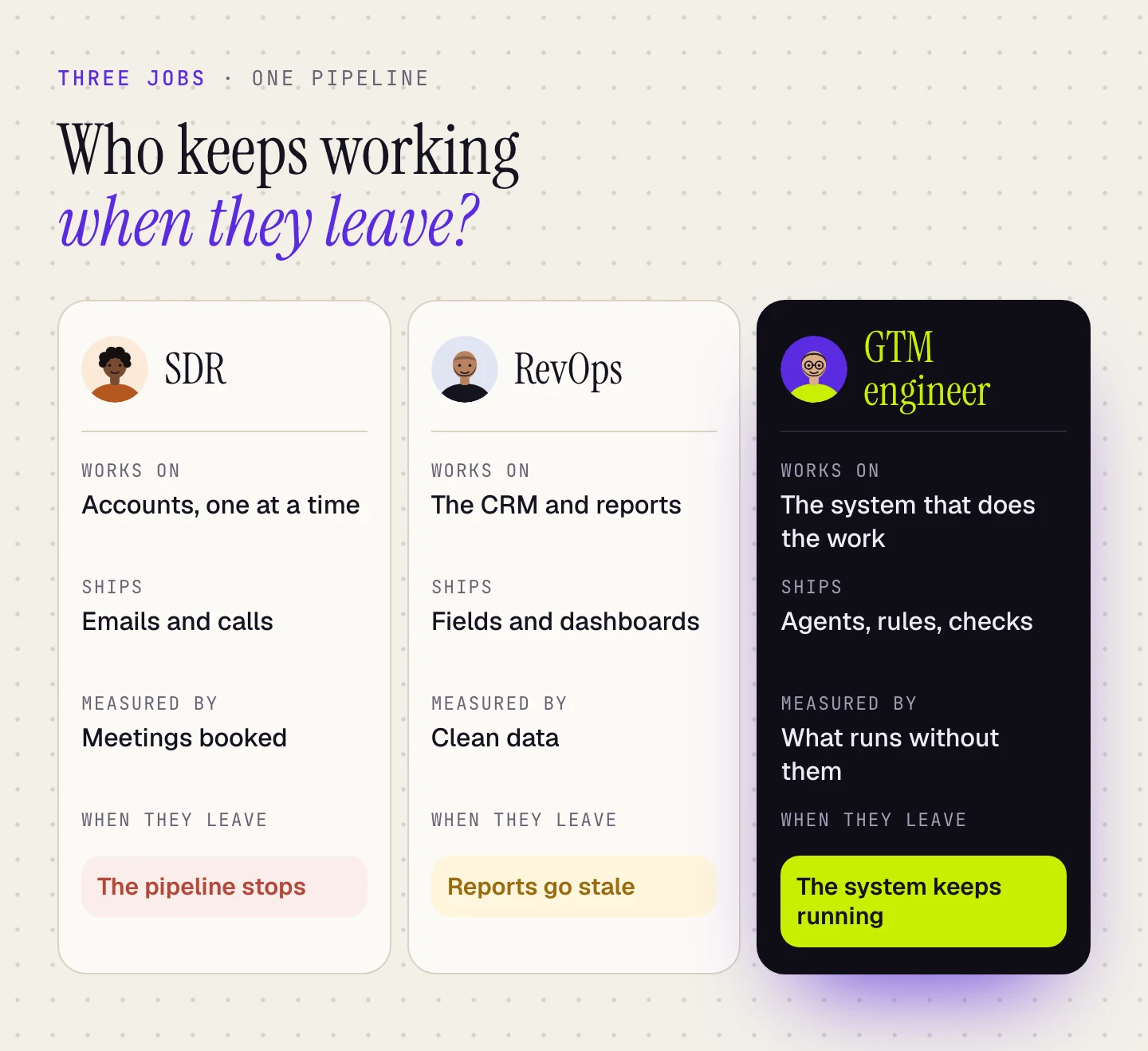
That last question is the one that matters. When an SDR leaves, their pipeline stops. When a GTM engineer leaves, the system keeps running, because the context lives in it, not in their head.
What a GTM engineer actually builds
Here is our own system, the one in the first picture. Each part exists because something broke without it.
| Part | What broke without it |
|---|---|
| Second Brain | Rules scattered across too many places, with contradictions in prices and numbers |
| Research agent + list spec | Part of a list had almost no sales team, for a pitch about scaling sales teams |
| Copy gates | A variable broke in a campaign nobody approved |
| Sending governor | Mailboxes sat idle on weekdays, and limits were changed by hand |
| Reply routine | Positive replies waited until someone had time |
| /prep and /after-call | Promises owed and unsent across open deals |
| Weekly learning agent | Most campaigns had no results file |
The full walkthrough of every part is in our agentic outbound breakdown. Here I want to show the job itself: what the person building this ships in a normal week.
They ship rules, with evidence
The most common thing a GTM engineer ships is not code. It's a rule with evidence behind it.
Our own example: one type of mailbox brought almost no positive replies while another brought far more. The weekly agent wrote that up as a lesson. I signed it, and it became a hard rule.
Then the part most teams skip. A week later the weekly agent found mailboxes of the wrong type still attached to a live campaign and flagged it. A rule written down is not a rule followed, so the system checks itself.
They ship gates, enforced in code
In July an agent of ours launched a campaign on its own. People got copy nobody approved, with a variable that broke on some rows.
The fix was not a stern note in a prompt. It was a hook that blocks the launch until a person approves the copy and the launch, in the same session. One hook did more than a folder of memory files explaining why not to do it.
That is GTM engineering in one sentence: find the dangerous action, and make it impossible without a click.
They ship speed nobody has to remember
Before our reply routine, a positive reply waited until someone had time. Now a positive reply starts an agent within minutes. It reads the thread, builds a personal strategy page for that company, checks it and answers.
Nobody made the team faster. The GTM engineer made the waiting impossible.
A week in the life of a GTM engineer
Most of the work runs on its own: the governor every night, the reply routine every few minutes, the learning agent every Monday morning. The person's week is built around the few things only a person should do.
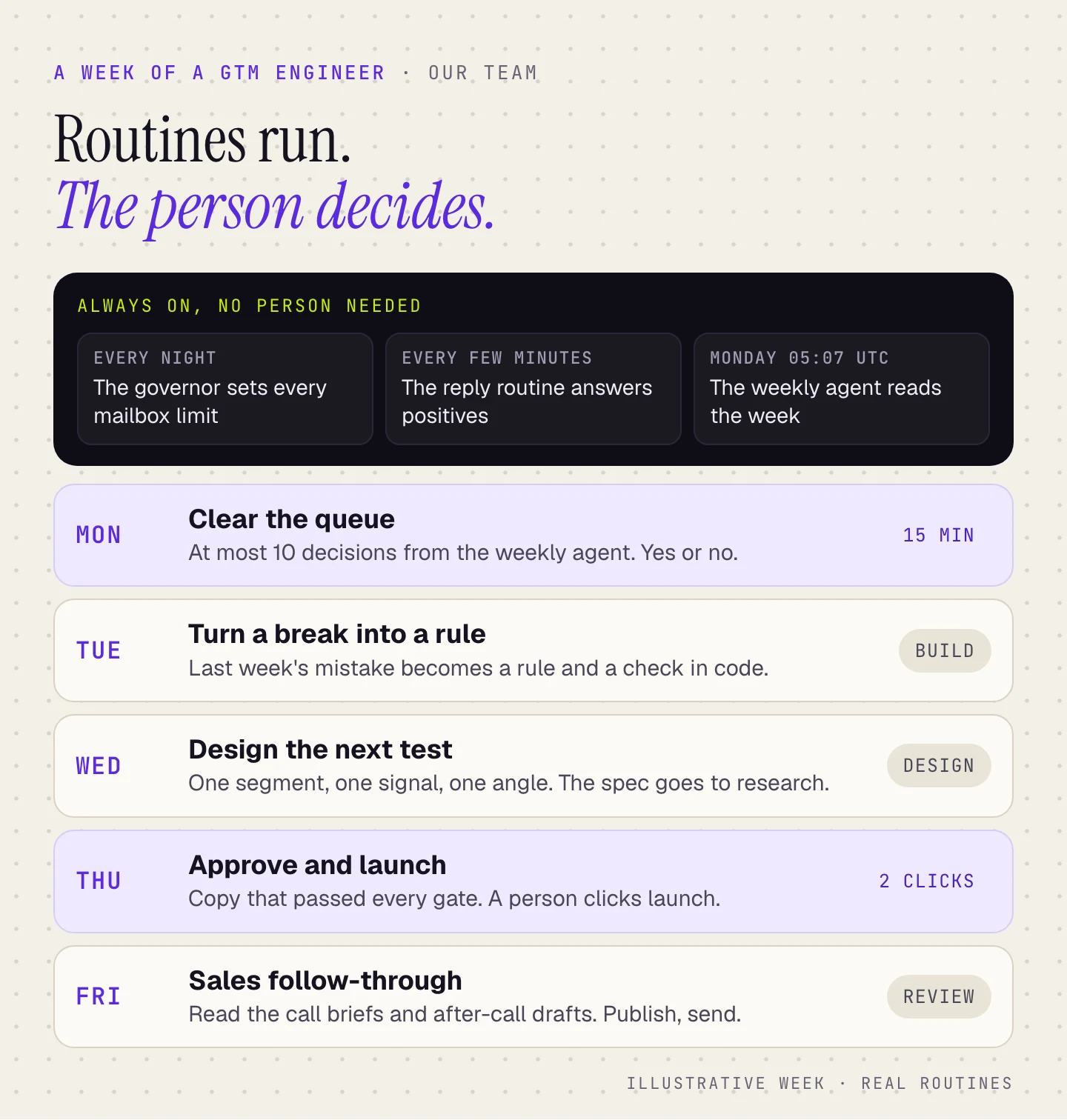
Monday starts with the queue. The weekly agent has already read every campaign and every reply. One card asked whether to pause the weaker of two offers. I tapped yes.
The rest of the week is building. Usually it's last week's break turning into this week's rule. This week, a re-engagement list was about to send the same email to people who had just got it. By the afternoon there was a CRM field, a list script that respects it, a lesson and a decision record.
The skills a GTM engineer needs
Job posts list tools. The tools change every quarter. These are the skills that stayed constant in our team, most of them learned the hard way.
- Outbound craft. Lists, copy and deliverability. You can't automate a job you can't do by hand.
- Systems. Git, a terminal, APIs, webhooks, a scheduler. Our whole memory is one repository with one record per file.
- Agent design. Narrow jobs and separate checks. The writer never grades itself.
- Measurement. One segment, one signal, one angle per test, and a rule for when to kill or scale it.
- Guardrails in code. The dangerous rules live in hooks, not in prompts.
- Judgment. Knowing what never to automate. Our simulated readers said nobody would reply, round after round, while comparable real copy did get replies. A GTM engineer trusts the market over the model.
If you want to see the tools side, our Claude Code for GTM post has the skills and the stack from our webinar.
How to start: hire one, or start with a team that runs it
There are two honest ways in.
Hire a GTM engineer. Right if you want the system in-house for years and you have someone senior who can judge their work. The catch: a good one builds from zero, the memory first, then each layer. And they can only build what they have already seen work.
Start with a team that already runs the system. We build it on your own data (your CRM, calls, ICP and past campaigns) and run it next to your team for six weeks. You keep the gates. The pilot is $2,000. In week six you decide on real replies and meeting quality. If it works, we continue, priced by volume. If not, you stop. No auto-renewal, and if you leave, the domains, mailboxes and stats go with you.
You can see what the system looks like on the Agentic Outbound page.
Either way, build in this order. Each step pays off on its own:
- One place for the memory. Prices, numbers, rules and decisions, each with a date and a source.
- A check after every agent. Nothing grades its own work.
- Hard gates in code. Launch, send and spend wait for a click.
- A weekly agent that reads results and writes lessons with evidence.
- Then autonomy, one case at a time. Drafts first, then samples, then live.
Want the whole system chapter by chapter, with the 45-minute recording where I run it live? Get the free playbook here →
What is GTM engineering?
GTM engineering is building go-to-market as a system instead of staffing it as a set of jobs. A GTM engineer builds the shared memory, the agents, the checks and the learning loop that research, write, send and follow up, while people keep the decisions about tests, copy, launches and spend.
What is the difference between GTM and sales?
GTM, go-to-market, is the whole path from picking a market to a closed deal: who you target, the offer, the channels, the data and the follow-up. Sales is one part of it, the conversations that turn interest into a deal. A GTM engineer builds the system around those conversations; the sales call itself stays human.
How do you become a GTM engineer?
Learn the work by hand first: build a list, write a sequence, set up sending and answer replies. Then automate one part at a time with agents and scripts, and put a separate check after each one. Coming from an SDR, RevOps or growth role helps, because you already know the work you are automating. The systems side is learned by building for a real team, not from a course.
Is GTM engineer a good role?
It is a good role for people who like building systems more than working accounts one at a time, and who can write code or work with agents. It is a hard role if the company expects one person to also run strategy and close deals. The job only works when the business owns the offer and the call.
Should I hire a GTM engineer or work with an agency?
Hire one if you want the system in-house long term and someone senior can judge the work. Start with a team that already runs the system if you want it working in weeks and want to see results on your own market before you hire. Make sure everything built stays yours either way.
Put an outbound team of AI agents in your Slack
Strategy, research, copy and deliverability agents working on your company's context, built and run with you.

Ilya AzovtsevCo-founder
Co-founder of GrowthBand. Helped scale lemlist from $20k MRR to $10M ARR and built automation at Expandi; now runs the cold email infrastructure behind 35,000+ mailboxes.