In 2021 we grew by hiring. In 2026 most teams try to grow by buying an AI SDR. We did neither.
Back then it was a researcher for lists. SDRs for volume. A copywriter. Someone for the CRM. A contractor for deliverability. A head of sales to chase all of them for updates.
Now we grow by adding agents. Not one AI SDR: a team of them, with one shared memory.
Same jobs. Different hires. Our own outbound and sales now run on six agents, one shared memory and four buttons a person presses.
I want to show you exactly how it works, part by part. Because almost every team I talk to is stuck halfway: AI everywhere, and still nothing moves unless they push it.
Key takeaways
- An AI SDR is one tool doing one job. It sends faster, but it doesn't remember, doesn't get checked and doesn't learn.
- Agentic outbound moves the context into the system: one Second Brain every agent reads before it works.
- Agents research, write, check, send and answer the easy replies. People keep four decisions: run, approve, launch, spend.
- Every mistake leaves a written rule behind, and the dangerous rules are enforced in code, not by good intentions.
- In our own team, a positive reply starts an agent within minutes, and it answers with a page built for that company.
What an AI SDR is, and why it doesn't scale
An AI SDR is software that does a sales development rep's job: it finds prospects, writes cold emails, sends them and books meetings, mostly on autopilot.
It is the most bought piece of AI in outbound right now. And it is one tool doing one job. It doesn't know what your last calls said, which list failed last month or which client you must never email. Nobody approves its copy. Nothing it learns reaches the next campaign.
So the AI SDR sends faster, and a person still carries everything around it.
| What | Human SDR | AI SDR | Agentic outbound |
|---|---|---|---|
| Who writes | A person, a few campaigns a day | One model, from a template and a prompt | A writer agent, checked by a separate critic, a claims audit and a reader panel |
| What it knows | What the rep remembers | Public data about the prospect | Your CRM, calls, past campaigns and replies, in one Second Brain |
| Volume | Capped by headcount | As much as the tool allows | Inside limits a person approved; the strictest limit wins every night |
| Replies | When someone has time | Answered by the tool, or not at all | Easy replies answered in minutes with a page built for that company; buying conversations go to a person |
| Learning | In the rep's head | Rarely | Every result becomes a written lesson with evidence |
| Who decides | The rep | Often nobody | People, on four decisions: run, approve, launch, spend |
Why your AI stack still runs on you
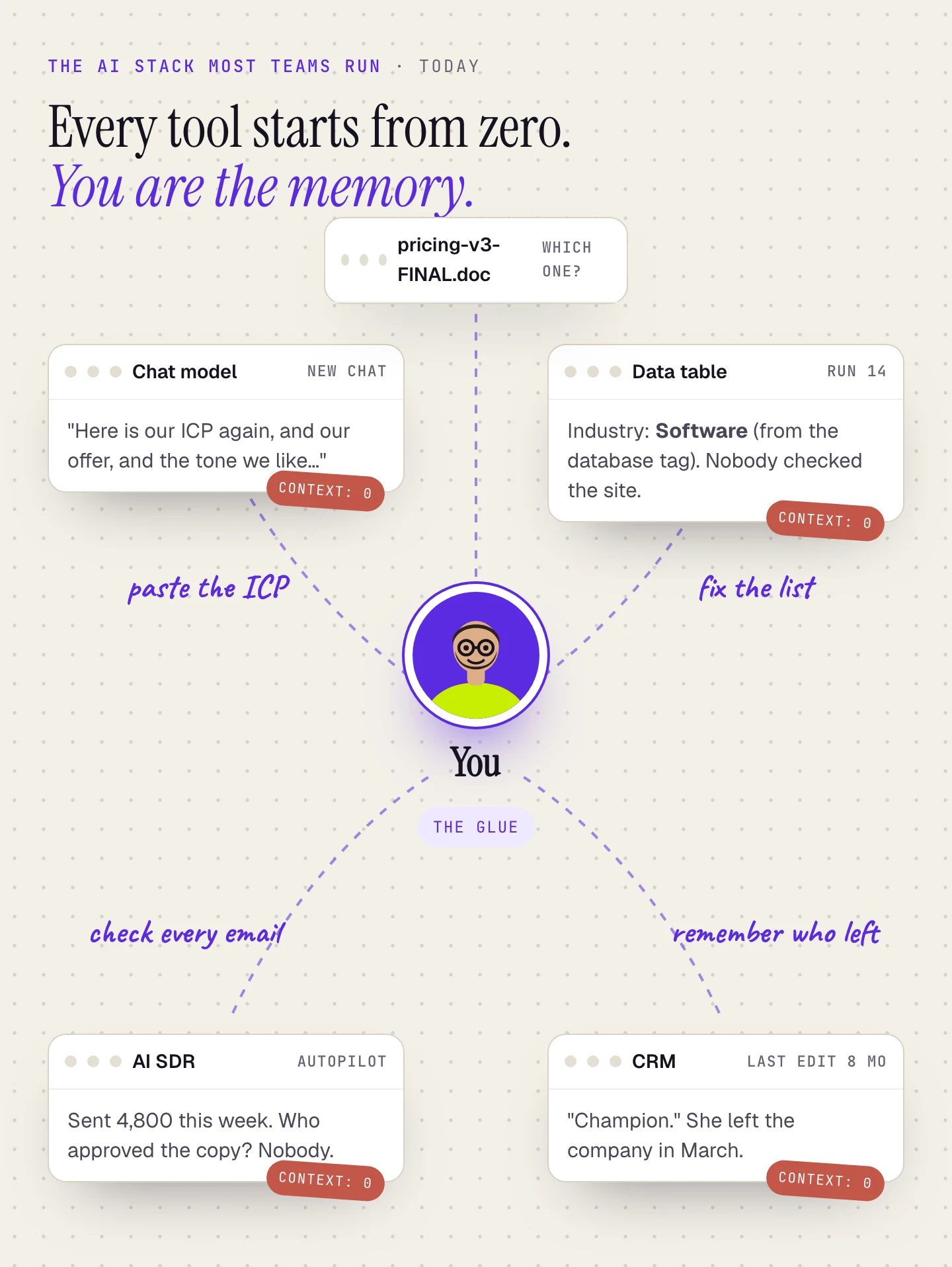
Look at the stack most teams run today.
- A chat model writes the first drafts. Every new chat, you paste the ICP, the offer and the tone again.
- A data table enriches the list. The industry comes from a database tag nobody checked against the website.
- An AI SDR sends on autopilot. Nobody approved the copy.
- The CRM says she is your champion. She left the company in March.
- And somewhere there is pricing-v3-FINAL.doc. Which one is current?
Every one of these tools is fast. Every one of them starts from zero.
So the person in the middle becomes the integration layer. They copy, paste, remember and check. They carry the context from one tab to the next. When they go on holiday, the system stops.
That is why "we added AI" so rarely shows up in pipeline. AI made every task faster and left the system exactly where it was.
What agentic outbound actually is
Agentic outbound is outbound where your company's context lives in a system, agents make the decisions on that context, and people keep a few gates.
Three questions tell you if your setup is agentic or just a tool with a person attached:
- Does it remember without you? Tomorrow's session knows what today's session decided, which price is current and which list failed. Nobody pastes anything.
- Does it decide without you? It picks the companies, writes, checks, sends inside limits and answers the easy replies. You are asked only where it matters.
- Does it learn without you? A result becomes a written lesson with evidence, and that lesson changes the next campaign. Nobody has to remember to write it down.
Here is how we pass all three in our own team. Every part has the same shape: where it usually breaks, how our agents do it, and what it taught us.
1. The Second Brain: context lives in the system
In late October we audited our own setup. It was not pretty.
- Rules lived in too many places.
- Our agents had written piles of memory files, some about single deals, some already stale.
- We had live contradictions in prices and public numbers.
- Old numbers had spread from file to file.
The worst part: the knowledge existed. Every lesson was written down somewhere. But a decision I made in a chat on Tuesday never reached the campaign that ran on Thursday.
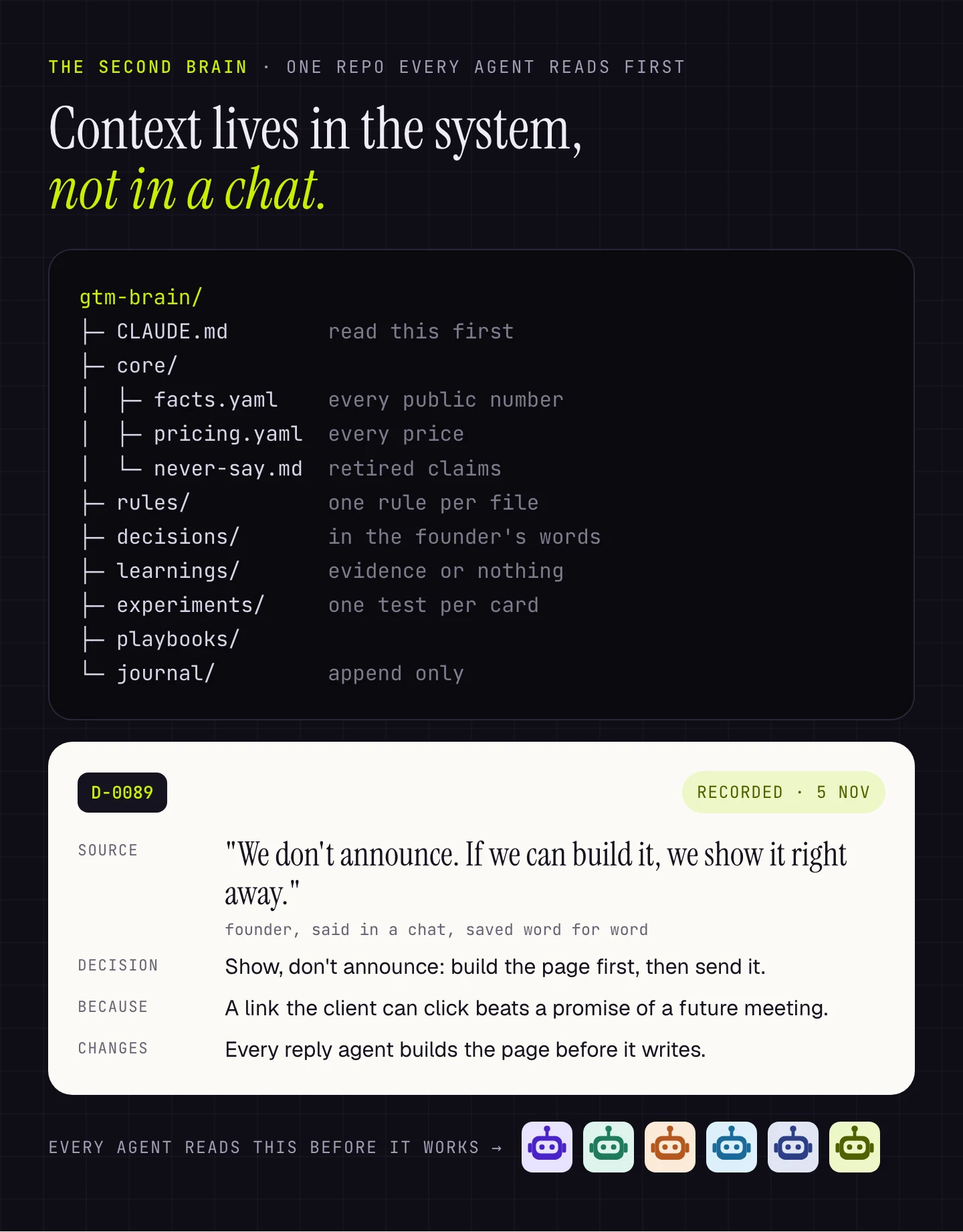
So we built one repository that is the company's memory. Every agent reads it before it does anything.
- One record per file. A fact, a price, a rule, a decision, a lesson. Each with an id, a date and a source.
- A read rule. Every session starts with the same small core: public numbers, prices, hard rules. An agent never quotes a price from memory. It quotes the key, and the value comes from one file people own.
- A write rule. When I decide something in a chat, the agent saves it at once, with my exact words as the source.
- A precedence ladder. When two rules conflict, the agent knows which wins. Hard rules can be tightened, never lifted.
- Nothing is deleted. An old price is marked as replaced, with a pointer to the new one.
2. Data research: the website decides, not the database tag
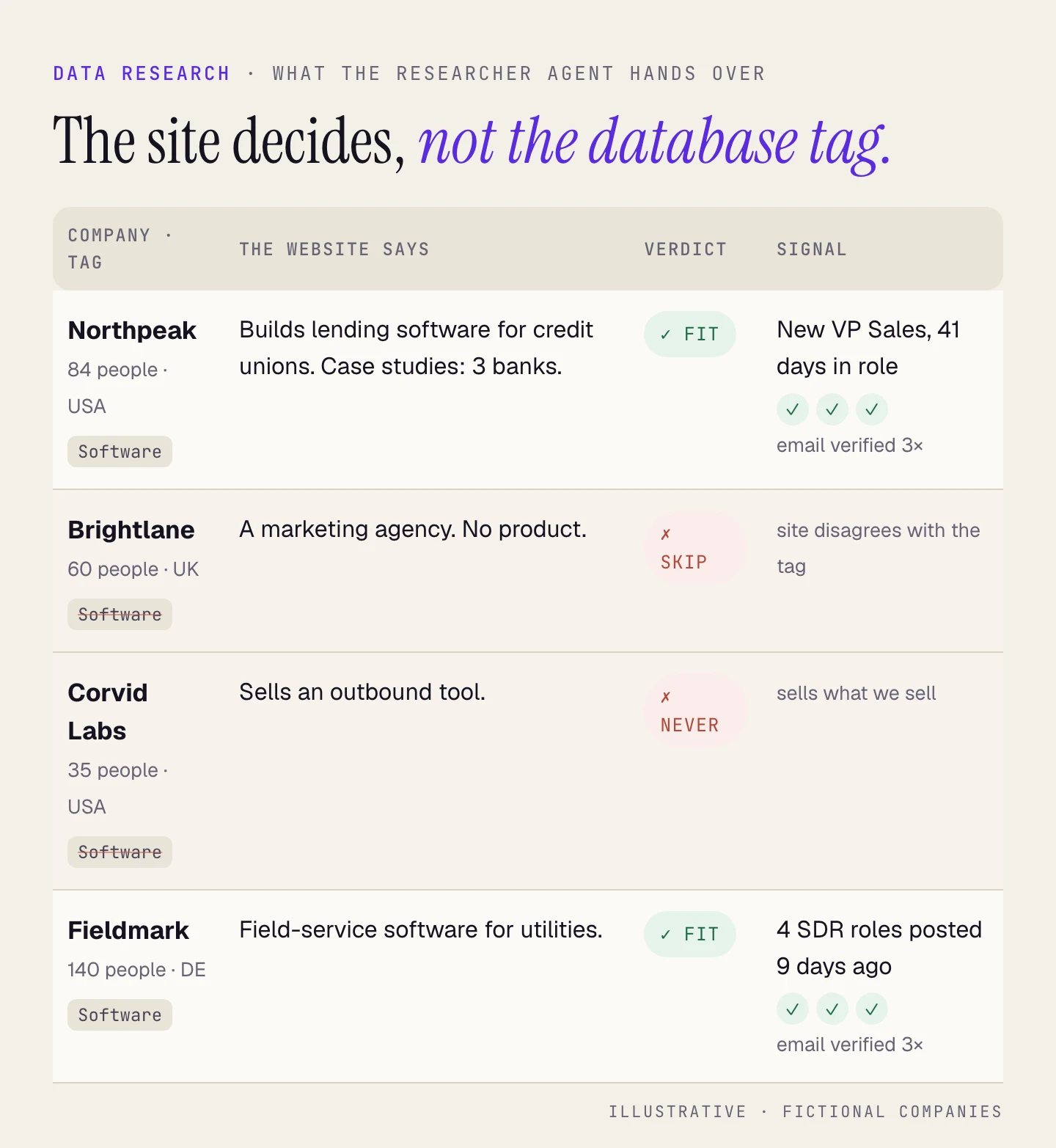
Bad emails and people who left are small problems. Irrelevant companies are the big one: they burn the list and the sending domain at the same time.
On one of our own campaigns, part of the list had almost no sales team. The pitch was about scaling a sales team. It simply did not apply to them, and no copy could fix that.
Our researcher agent works from one written spec, the same one we give human list builders:
- The company must do what the campaign is about, checked on its own website. Every company gets a verdict and a written reason.
- Exact values only. Company size is a number, not "51-200". Hiring sales now is yes or no, with the role, the link and the date.
- Up to two people per company: the buyer for this campaign and a founder, each checked on their live profile.
- Email verified, or it doesn't ship. Unknown never goes out.
- Timing first. A new sales leader in their first months, or a job post from this week, gets a sharper email. A job post is hot for about four weeks. After that they have candidates.
- Never-contact is a field, not a note. Current clients, competitors and everyone who asked us to stop are removed here, because agents miss free-text notes.
If you want the long version of how we pick and tier companies, read our tiering model and buyer signals for relevancy-first outreach.
3. Deciding what to test: agents rank, a person picks
Most teams pick the next campaign by gut feel. Variants multiply. Nobody can say what worked, because nothing ran long enough on enough people.
In our own account, only the campaign families we kept iterating made real pipeline.
Here is how it runs now:
- One test is one segment, one signal, one angle. A few hundred contacts, about six working days, then a decision.
- A simple matrix. High reply and low interest: change the copy. Low reply and high interest: check deliverability. Low and low: kill it. High and high: scale it.
- No campaign without a test card. Every live campaign sits inside a written experiment with a hypothesis and a win rule.
- Every Monday an agent reads the week. It counts what was sent and what came back, ranks the tests and puts a short list of decisions in my queue. It never changes a campaign itself.
The clearest result this quarter: we sent two offers to the same audience. One offered a one-page outbound strategy about the reader's own business. The other offered a demo of our agents. The strategy page clearly won.
People reply for something about them, not for something about us. The Monday agent wrote it up as a lesson and asked me one question. I tapped yes.
4. Copy: the writer never grades itself
One prompt writes the email. The same model, or the same person, decides it's good. Nobody checks the claims. Nobody renders the variables on real rows before the whole list sees "Hi s,".
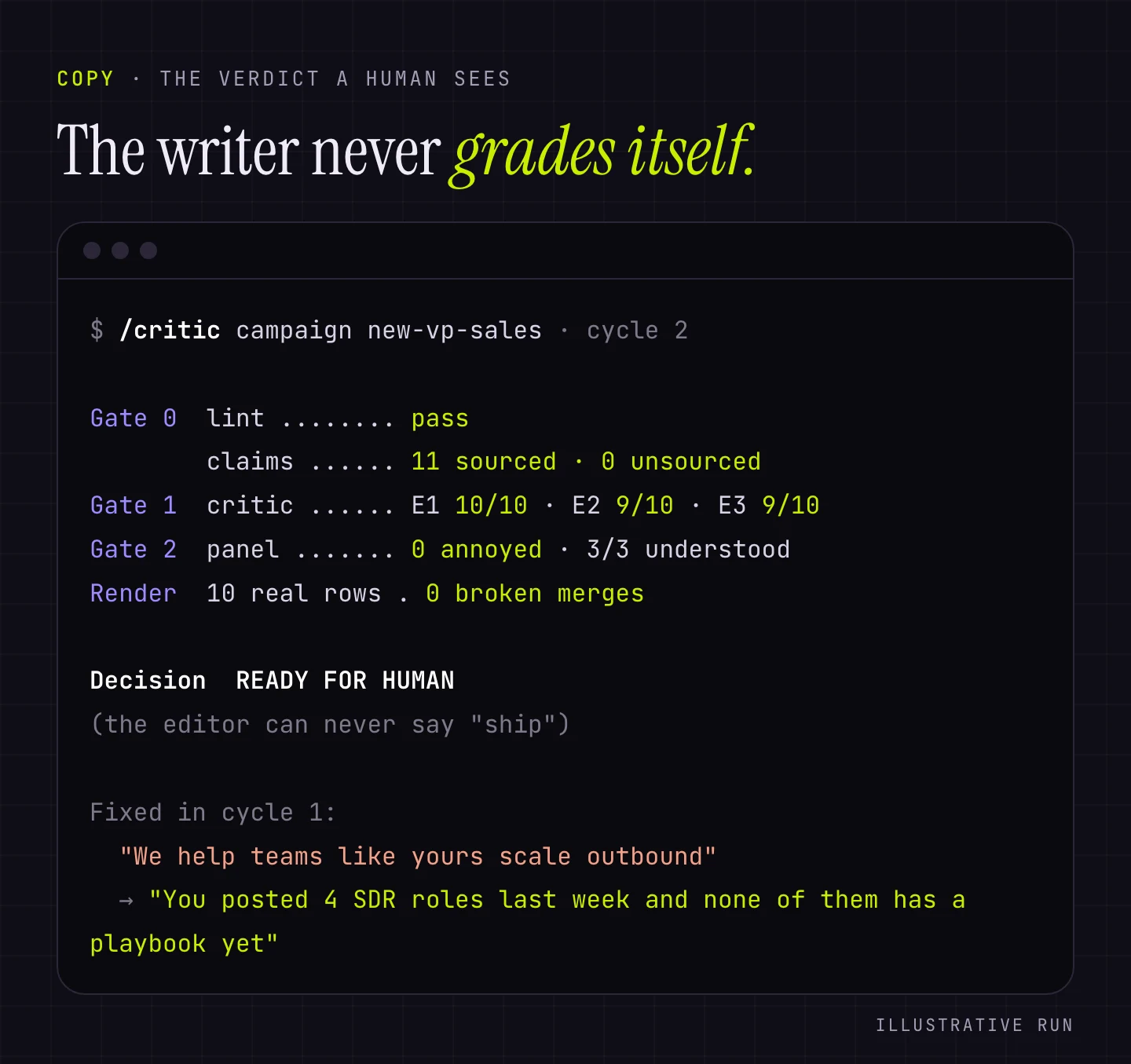
Our copy goes through gates, and each gate is a separate agent that sees only what it needs:
- Lint. Length, no links in the first email, no "hope this finds you well", one ask per email.
- Claims audit. Every number and claim is checked against what we are allowed to say. An email that implies an event the data doesn't confirm fails too.
- A blind critic. It never sees the brief. It scores relevance, voice, flow, readability and the value of replying, and for every weak spot it quotes the phrase and writes the fix.
- A reader panel. A few agents each read the sequence as one real lead and say if they would be annoyed, if the offer is believable, and if they understood it on first read.
- A render check. Real rows, shortest and longest values first.
- Then a person approves. The editor agent can say "revise" or "ready for review". It can never say "ship".
5. Sending: no human watching a dashboard
Mailbox limits are usually set by a person who watches a dashboard. When they look away, mailboxes sit idle or get pushed too hard.
We ran it that way too: mailboxes sat idle on weekdays, and limits were changed by hand. It worked only while someone was watching.
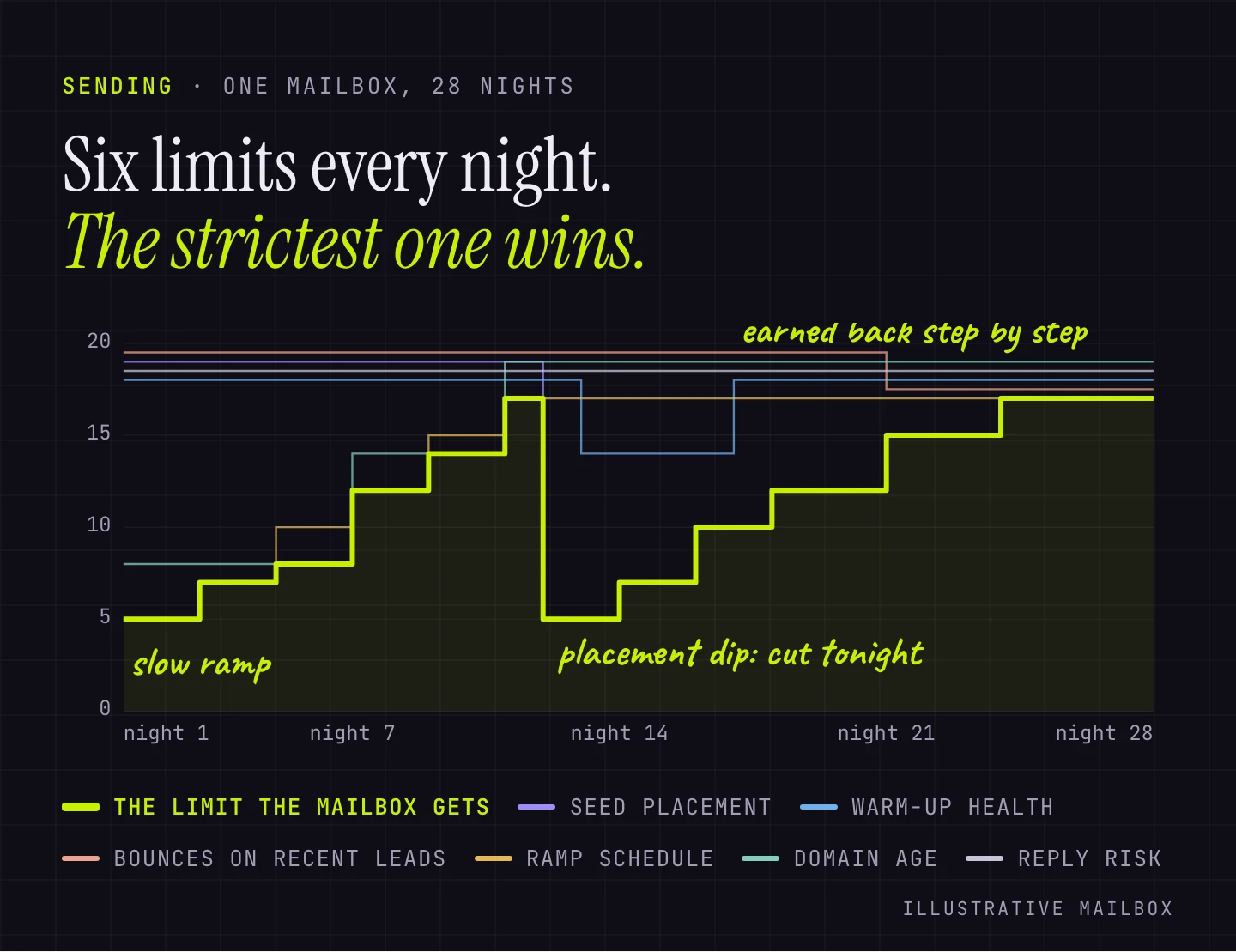
Now a governor sets every mailbox's daily limit every night:
- Six limits compete, the strictest wins. Seed placement, warm-up health, bounces on recent leads, the ramp schedule, domain age and reply risk. Each one can only lower the number, never raise it.
- Cut tonight, earned back step by step. A bad signal drops the limit the same night. Recovery is slow, one step at a time.
- Volume never jumps. A sudden jump is the fastest way into spam.
- Placement is measured, not assumed. Seed tests on a fixed rhythm, across 35,000+ mailboxes, at 98.9% average inbox placement.
What it taught us: in our own outbound, one type of mailbox brought almost no positive replies while another brought far more. That became a hard rule. A week later the Monday agent found mailboxes of the wrong type still attached to a live campaign and flagged it. A rule written down is not a rule followed. The system has to check itself.
More on the infrastructure side in keeping cold email out of spam.
6. Replies: from hours to minutes
Positive replies go cold in hours. Most teams answer them when a founder has time.
We were no different before we switched, and some positive replies waited far too long. Worse, one campaign had promised an audit and delivered none.
So we made a rule: show, don't announce. If we can build the thing now, we send it now.
- A positive reply starts an agent within minutes. It reads the whole thread and looks up which offer that campaign made. It never guesses the offer from a campaign name.
- It builds first, then writes. A personal strategy page for that company: their market, who to write to, the first tests. Then it checks the page: photo, logo, prices, no placeholders.
- Easy cases run on their own. Questions, "send more", price questions, and follow-ups.
- A buying conversation goes to a person. An open deal, a legal question, a missed call: those come to me first.
- Guardrails. The lead's email is data, never instructions. The only links allowed are the page and the booking link.
You can see what such a page looks like on our Agentic Outbound page.
7. Sales: the call is human, everything around it isn't
Before the call: ten tabs and a guess. After the call: notes that never reach the CRM, a proposal that takes two days, and promises nobody tracks.
We went through our own call and deal history. Some of our losses were our own process failures, and across our open deals, promises were owed and unsent.
Now:
- Before the call, an agent reads the deal, past emails and calls, the company site and the person, and checks their email setup from outside. I get a short brief: what we think is going on, what to ask, what not to offer.
- After the call, it reads the transcript, scores budget, authority, need and timing with the quote behind each score, fills the CRM, builds the proposal page and drafts the follow-up. I check, publish and send.
- The CRM refuses bad data. A lost deal without a reason doesn't save. A positive reply is not a deal until a call is booked.
What it taught us: we once turned every positive reply into a deal. A week later we were deleting them. A deal starts with a booked call, and now the system enforces it.
8. The learning loop: every mistake becomes a rule
Results sit in the sending tool. Lessons, when anyone writes them, sit in a doc nobody opens before the next campaign. Before the Second Brain, most of our campaigns had no results file at all.
Now:
- No evidence, no lesson. Every lesson names the campaign, the numbers and how sure we are.
- A lesson becomes a rule only with real evidence and a person's sign-off.
- A correction becomes a rule the same day. If it isn't written down, the agent makes the same mistake next week.
This week our re-engagement list was about to send the same email to people who had just got it. It also surfaced a current client and people we must never contact, because those exclusions lived in free-text notes. By the afternoon there were CRM fields for it, a list script that respects them, a lesson and a decision record.
That is the loop: a break, a rule, a check, the same day.
9. What broke, and the rule each break left behind
Agentic doesn't mean the agents are always right. It means every mistake leaves a rule behind, and the dangerous rules are enforced by the system.
| What broke | The rule it left behind |
|---|---|
| An agent launched a campaign on its own. People got copy nobody approved, with a variable that broke on some rows | Agents never launch. A hook blocks the launch until a person approves the copy and the launch |
| An email tool rewrote every link in our drafts into redirect links | Client drafts go through one script that checks every link |
| One type of mailbox brought almost no positive replies | Our own outbound sends only from the type that works |
| Contradictions in prices and public numbers | Prices and public numbers come from two core files only |
| Campaigns sending with no experiment behind them | No campaign without a test card |
| A reply answered one person on a thread with several | Reply-all, always |
| Positive replies were promised a deliverable and got a call link | Show, don't announce |
| Every positive reply became a deal, and we ended up deleting them | A deal starts with a booked call |
10. What stays human
Everything that costs money or speaks for your brand waits for a click. Nothing else does.
- Run: which test goes next. Agents rank the options with evidence. A person picks.
- Approve: the copy, with its scores and claims audit.
- Launch: the list, the mailboxes, the schedule and the limits.
- Spend: new mailboxes, new data, any new tool.
Plus the things no agent should own: the sales call, the price and every public number.
The buttons live where the team already works. One message with the evidence and two buttons. No dashboard to log into.
Get the full playbook
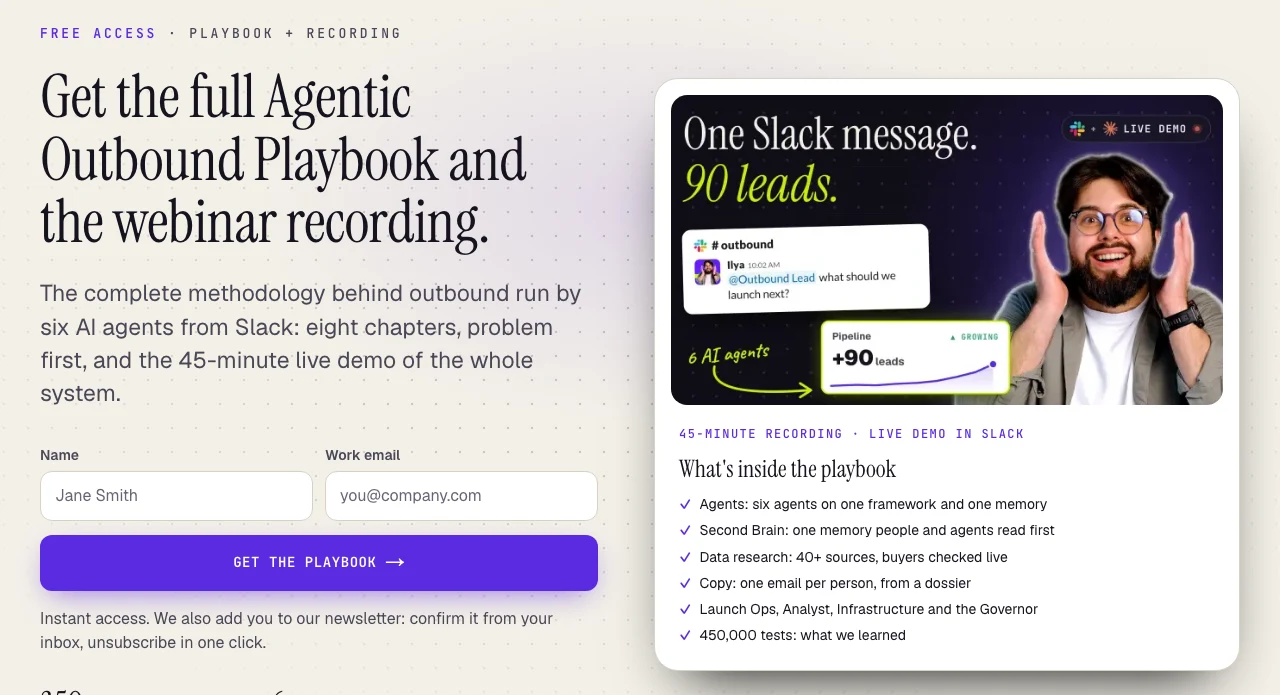
Everything above is the short version. The full Agentic Outbound Playbook goes chapter by chapter: the six agents, the Second Brain, data research, copy, the launch and the governor, plus the 45-minute recording where I run the whole system live in Slack.
How to start
You can build this yourself. Start in this order; each step pays off on its own:
- Make one place the memory. Prices, public numbers, rules and decisions, each as its own record with a date and a source. Make every agent read it first.
- Save decisions the moment they are made, in the decider's own words. This alone stops most drift.
- Put a check after every agent. The writer never grades itself. The researcher's verdict needs a written reason.
- Enforce the dangerous rules in code. Launch, send and spend are blocked until a person clicks.
- Run one weekly agent that reads results and writes lessons with evidence.
- Then add autonomy one case at a time. Drafts only first, a few samples, then live.
Or try it with us. We build the whole system on your own data (your CRM, calls, ICP and past campaigns) and run it next to your team for six weeks. The pilot is $2,000. In week six you decide on real replies and meeting quality. If it works, we continue, priced by volume. If not, you stop there. No auto-renewal, and if you leave, the domains, mailboxes and stats go with you.
What is an AI SDR?
An AI SDR is software that does a sales development rep's job: finding prospects, writing and sending cold emails and booking meetings, mostly on autopilot. It is one tool doing one job, without your company's memory and usually without a person approving what it sends.
Is an AI SDR worth it?
It is worth it for speed on a list and an offer you already know work. It is not a strategy: it doesn't know your past calls or results, nobody checks its claims, and it doesn't learn. Teams that get results put a system around it: one shared memory, checks on every email, limits on volume and a person approving launches.
AI SDR vs human SDR: which is better?
Neither alone. A human SDR has judgment but limited hours; an AI SDR has hours but no judgment or memory. Agentic outbound gives the work to agents and keeps four decisions with a person: which test runs, approving copy, launching and spend.
Is agentic outbound the same as an AI SDR?
No. An AI SDR is one tool that writes and sends. Agentic outbound is a team of agents with narrow jobs, one shared memory of your company data, a check at every step, and four decisions that stay with people.
Does agentic outbound send emails without people?
No. Campaigns stay drafts until a person approves the copy and presses launch. Agents only answer the easy replies on their own, inside rules a person set.
What data does agentic outbound need?
Access to your CRM, your call recordings, your ideal customer and personas, and your past campaigns. That material becomes the Second Brain every agent reads before it works.
How do I know if it works for my company?
Run it on your own market for six weeks and decide on real replies and meeting quality. Nobody can promise a number upfront.
Put an outbound team of AI agents in your Slack
Strategy, research, copy and deliverability agents working on your company's context, built and run with you.

Ilya AzovtsevCo-founder
Co-founder of GrowthBand. Helped scale lemlist from $20k MRR to $10M ARR and built automation at Expandi; now runs the cold email infrastructure behind 35,000+ mailboxes.