Heyo!
We build outbound systems for B2B sales teams. 50% of our clients are IT outsourcing companies - and most of them start getting qualified SQLs within the first month of working with us.
I've wanted to write this guide for a while. Not the "5 tips for better cold email" kind of post - but the actual system we run daily for dev agencies across Eastern Europe, Latin America, and South Asia.
Everything here is based on real campaigns. Real data. Real results.

If you run an IT outsourcing agency and you're tired of depending on Upwork, Clutch, or hoping referrals keep coming, this guide is for you.
But before we dive deep → make sure you get our Outbound Starter Pack (check below) 👇️
The Problem: Why Standard Outbound Fails for IT Agencies
Here's what most dev shops do when they "try outbound":
- Pull 5,000 CTOs at startups from Apollo or LinkedIn Sales Navigator
- Write something like "Hi {FirstName}, I noticed your company is growing..."
- Send it to everyone
- Get a 0.5% reply rate
- Conclude that "cold email doesn't work for us"
Sound familiar?
The problem isn't the channel. The problem is the approach.
Here's what's actually happening in your prospect's inbox:
CTOs at growing companies receive 50+ cold emails per week from agencies. And almost all of them say the same thing:
"We have senior developers in Eastern Europe. Staff augmentation or dedicated teams. Let's jump on a quick call."
They delete these on autopilot. Not because they don't need help - but because nothing in that email gives them a reason to respond RIGHT NOW.
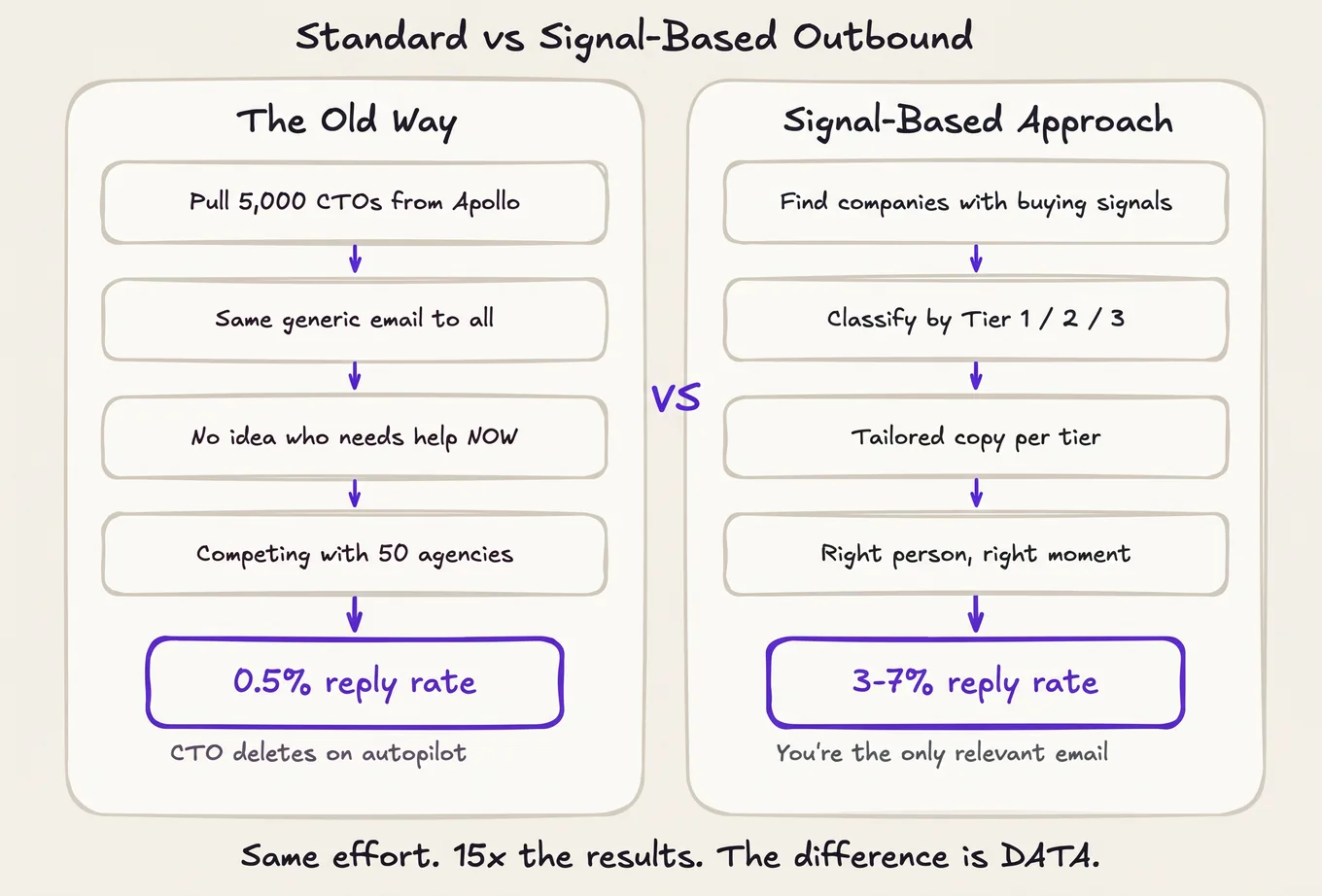
Think about it from the CTO's perspective. They might actually need 3 more React developers. But your email looks identical to the 12 other agency emails they got this week. There's no signal that you understand their specific situation. No reason to reply to YOU instead of just... doing nothing.
The shift that changes everything:
Instead of asking "who matches our ICP?" - ask "who needs our help RIGHT NOW, and how do we know?"
That's the foundation of everything that follows.
The Core Framework: Tier 1 / 2 / 3 Data Research
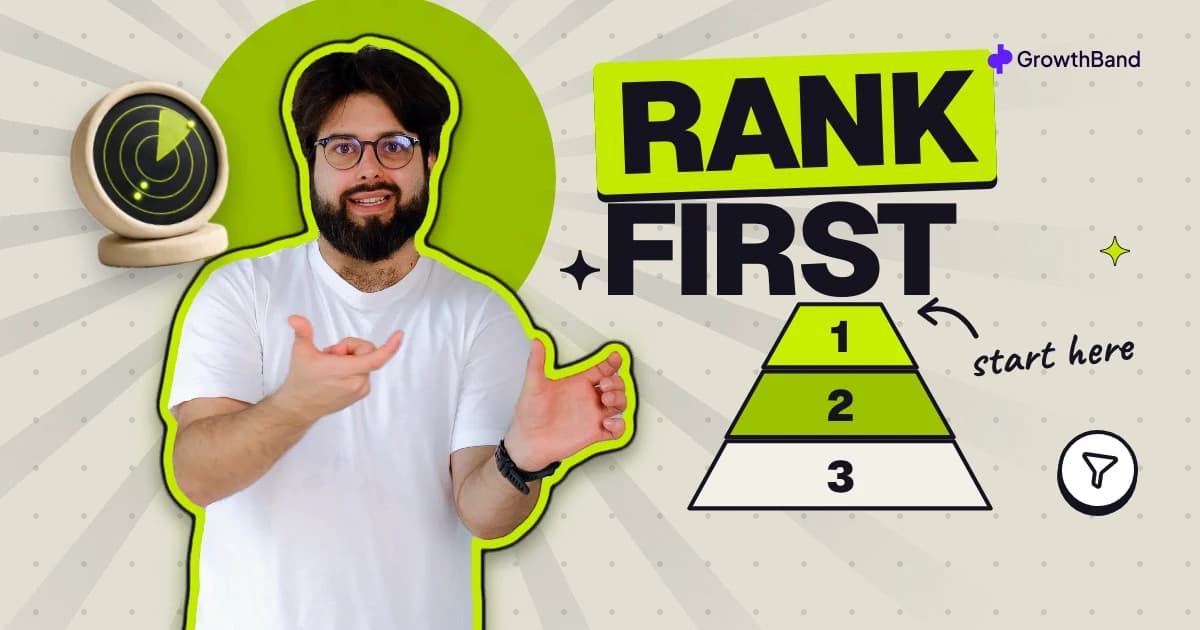
This is the system we use for every IT outsourcing client. Instead of sending the same emails to everyone, we segment prospects by signal strength - and then match each segment with the right copy approach, CTA, and volume.
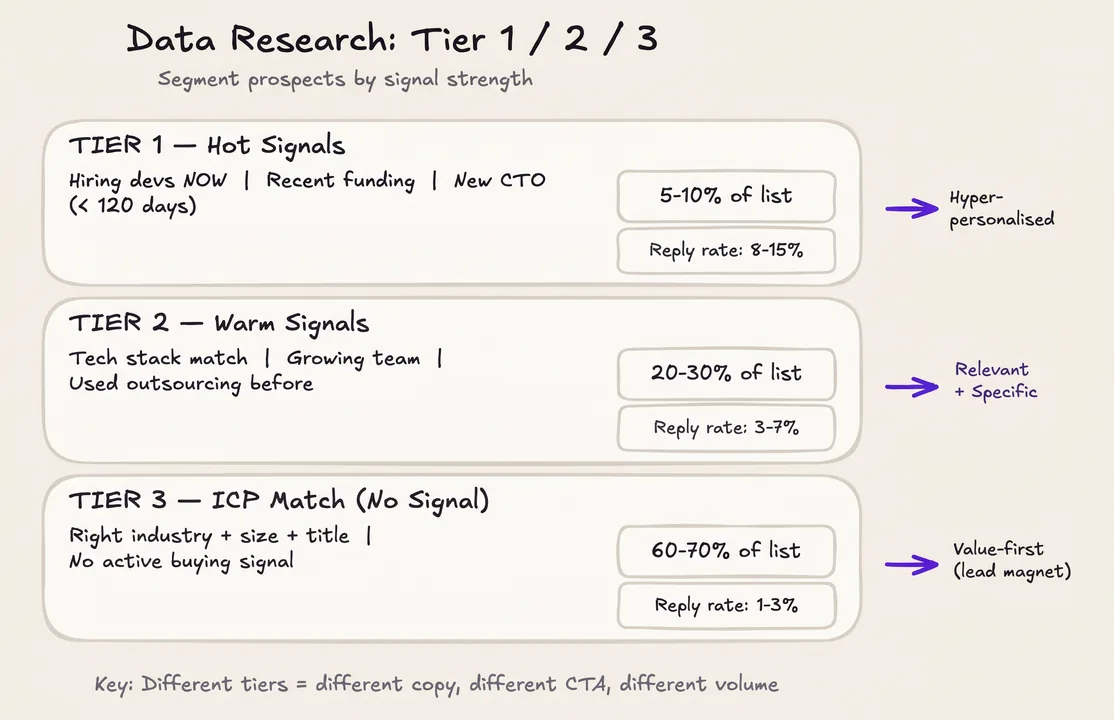
The logic is simple: not all prospects are equal. Some are actively looking for help right now. Some show indirect signs they might need help soon. And most are just... companies that fit your profile but aren't showing any particular signal.
Each group needs a completely different approach. Sending the same email to all three is the #1 reason outbound fails for IT agencies.
Let's break down each tier.
Tier 1: Hot Signals (5-10% of Your List)
These are companies that need development help RIGHT NOW. You can see it in their public behavior. They're not hiding it - you just need to know where to look.
I’ll also show you how to get those signals out of Clay.com.
(Btw, if you sign up with this link → you get extra 3k credits for free: https://clay.com/?via=leadgen)
The Signals
1. Actively hiring developers (Indeed, LinkedIn Jobs)
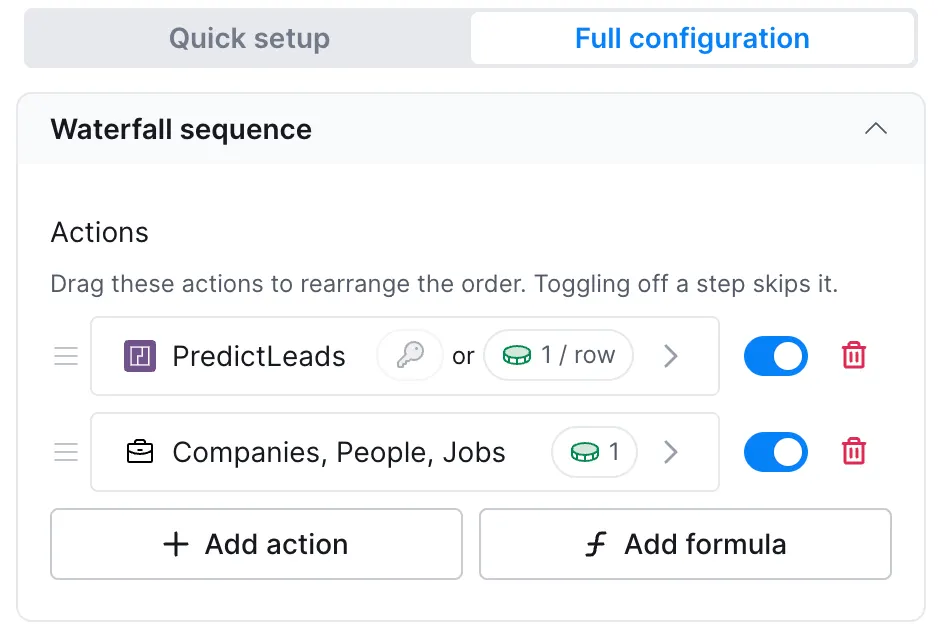
This is the single strongest signal for IT outsourcing agencies.
When a company posts 3+ developer job openings, it means one of two things: they can't find talent locally fast enough, or they want to scale faster than their hiring pipeline allows. Both are problems you solve.
The key detail most agencies miss: don't just look at the fact that they're hiring. Look at WHAT they're hiring for.
If they're posting React and Node.js roles and that's your specialty - that's a Tier 1 match. If they're hiring Rust developers and you don't do Rust - that's not your prospect.
2. Recent funding (last 90 days)
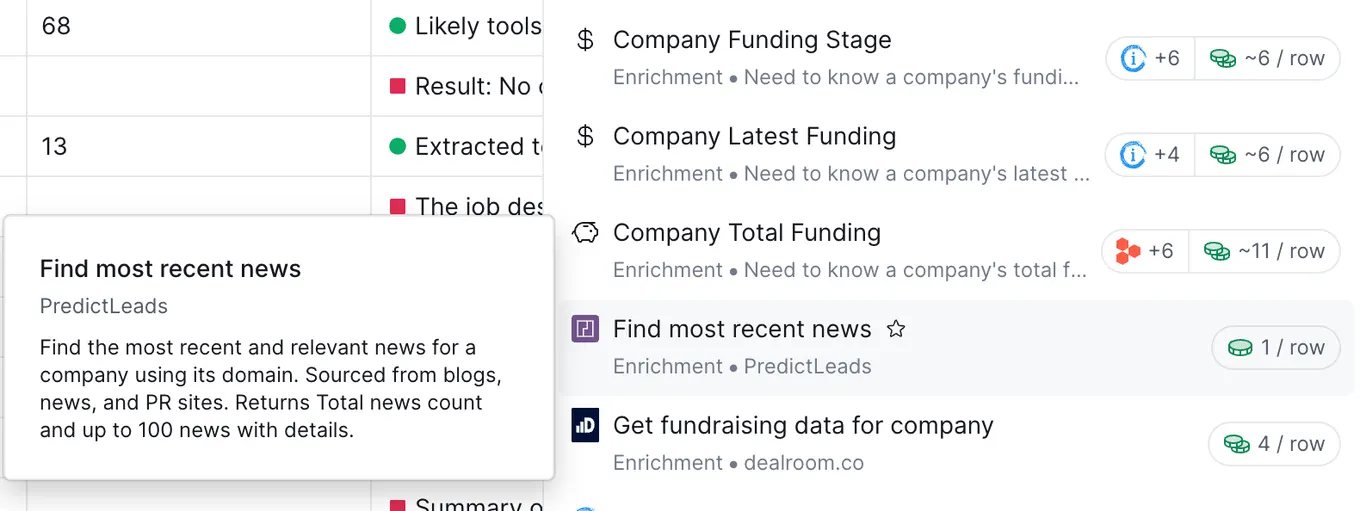
When a company raises a Series A, B, or growth round, the money needs to go somewhere. In most cases, a significant chunk goes to product development - which means hiring engineers or augmenting the team.
The 90-day window matters. Right after funding, there's a burst of activity: new hires, new projects, expanded roadmaps. That's when CTOs are most receptive to "we can help you build faster."
Six months after funding? The team is already built. You missed the window.
3. New CTO/VP of Engineering (less than 120 days in role)
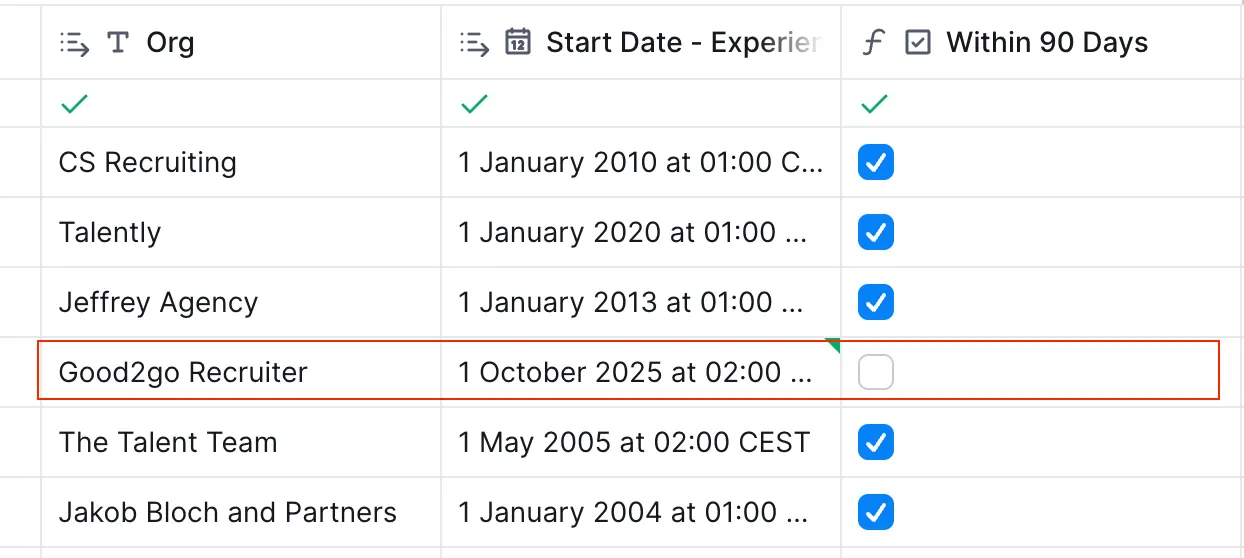
New engineering leaders do three things in their first 120 days:
- Assess the current team
- Identify gaps
- Build their own team and processes
This is a golden window. A new CTO is actively making decisions about team structure, tooling, and whether to hire or outsource. They haven't formed vendor relationships yet. They're open to conversations.
After 120 days? They've already made their decisions. The window closes.
4. Already have Eastern European developers on their team
This is one people overlook. If a company already has developers from Ukraine, Poland, Romania, or other EE countries on their LinkedIn team page - they're already comfortable with the outsourcing model. They understand the timezone dynamics. They know the quality of talent.
You're not selling them on the concept of outsourcing. You're just offering to help them do more of what they're already doing.
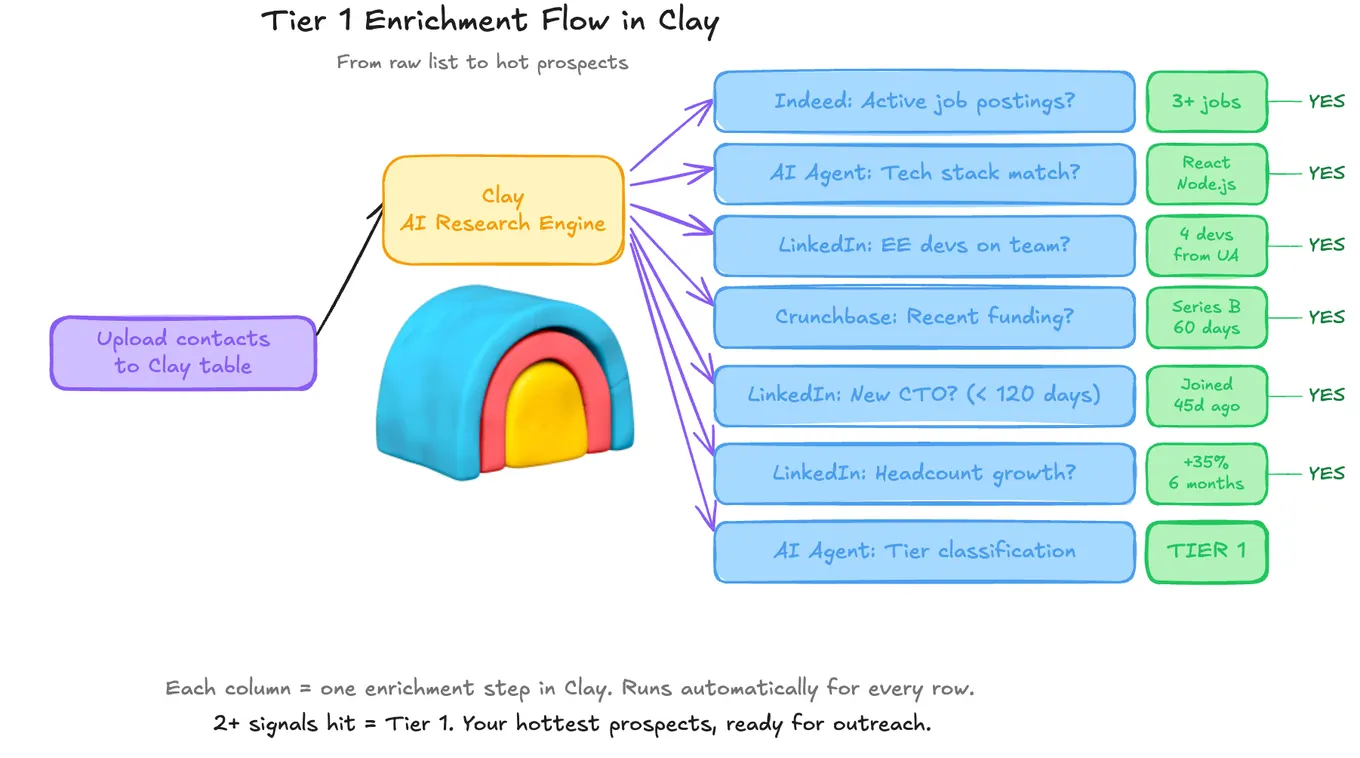
How We Find Tier 1 in Clay
Here's the actual workflow:
Step 1: LinkedIn Sales Navigator export - filter by company size, industry, and geography you want to target
Step 2: Indeed/LinkedIn Jobs scraping - pull companies that posted 3+ developer roles in the last 30 days
Step 3: Cross-reference - which companies from Step 1 are also hiring in Step 2?
Step 4: AI Research agent - for each company, check: do the job postings mention technologies you work with? (React, Node.js, Python, Java, etc.)
Step 5: LinkedIn Research agent - check how many developers from Eastern Europe already work at the company
Step 6: Crunchbase enrichment - check if they raised funding in the last 90 days
Any company that hits 2+ of these signals = Tier 1.
Copywriting for Tier 1

This is where most agencies still blow it. They have the right prospect but send the wrong email.
The wrong approach: "Hi John, I noticed your company is growing. We have senior developers in Eastern Europe who can help with your projects. Would you be open to a quick chat?"
The right approach: "Hi John - saw you're hiring 4 React engineers. Based on what I've seen, filling those roles takes 45-60 days on average. We helped [similar company] extend their React team with 3 senior devs in under 2 weeks - same sprint cycle, no onboarding overhead. Worth a 15-min look at how it works?"
The difference: the second email references their SPECIFIC situation (hiring React engineers) and addresses their SPECIFIC problem (the time it takes to fill those roles). It doesn't sound like a mass email because it isn't one.
Expected reply rate for Tier 1: 4-15%
That's not a typo. When you reach the right person at the right time with relevant context, the math changes completely.
Tier 2: Warm Signals (20-30% of Your List)
These are companies that match your ICP and show indirect signs they might need help - but nothing as obvious as active job postings or fresh funding.
The Signals
1. Decision maker joined recently
This is more subtle than the "new CTO" signal in Tier 1. Here we're looking at any relevant decision maker - Head of Engineering, VP of Product, Director of Technology - who joined in the last 6-12 months.
Why this matters: new leaders reshape things. They bring different preferences, different vendor relationships, and different priorities. A Head of Engineering who joined 4 months ago is still forming their approach. They're more open to new conversations than someone who's been in role for 3 years and has their systems locked in.
Important nuance: the copy approach changes based on HOW recently they joined. Someone who started 2 months ago gets a different email than someone who started 10 months ago. The first is still figuring things out. The second has already formed opinions but might be hitting their first scaling challenges.
2. Company is growing fast (20%+ headcount growth in 6 months)
Fast-growing companies have a universal problem: their engineering backlog grows faster than their team. Product wants to ship more features. Sales is closing deals that need custom work. And engineering is stretched thin.
These companies might not be actively looking for an outsourcing partner - but they're feeling the pain that makes them receptive to the conversation.
3. Previously worked with outsourcing agencies
You can see this on LinkedIn. Look at the company's employee list. If you see former developers from known agencies (or developers with agency experience in their background) - the company has used outsourcing before.
This changes the conversation entirely. You don't need to sell them on the concept. You just need to differentiate your approach from their previous experience.
How We Find Tier 2 in Clay
Step 1: LinkedIn enrichment for each decision maker - when did they start their current role?
Step 2: Company headcount analysis - pull headcount data from 6 months ago vs today. Flag companies growing 20%+
Step 3: LinkedIn Research agent - scan employee profiles for outsourcing agency backgrounds
Step 4: AI classification agent - takes all signals and assigns Tier 1, 2, or 3
Copywriting for Tier 2
The key difference from Tier 1: you know their context but not their exact problem. So your copy needs to be relevant and specific without being presumptuous.

For new decision makers: "Hi Sarah - congrats on the new role at [Company]. From what I've seen, the first 6 months as Head of Engineering usually involve a lot of team-building decisions. If you're evaluating how to scale the engineering team without a 3-month hiring cycle, I'd be happy to share what's working for similar companies in [their industry]. No pitch - just a quick perspective."
For fast-growing companies: "Hi David - [Company] went from ~80 to ~120 people this year. That kind of growth usually means the engineering backlog is growing faster than the team. If that's the case, I have a few approaches that helped other [industry] companies ship 2-3x faster without the hiring overhead. Worth a look?"
Expected reply rate for Tier 2: 3-7%
Lower than Tier 1 because the timing isn't as precise - but still dramatically better than spraying generic emails.
Tier 3: ICP Match, No Signal (60-70% of Your List)
Right industry, right company size, right job titles - but no active buying signal.
This is the majority of any list. And this is where most agencies make their biggest strategic mistake: they either ignore Tier 3 entirely (leaving 60-70% of their TAM untouched) or they treat it the same as Tier 1 and 2 (and tank their reply rates).
Why Tier 3 Actually Matters
Here's the thing most people miss about Tier 3: this is your testing ground.
With Tier 1 and 2, you have a relatively small number of prospects and a clear angle for each. But with Tier 3, you have volume. And volume means you can run real experiments.
A/B testing a subject line isn't enough. With Tier 3, you can test:
- Completely different angles (cost savings vs speed vs talent quality vs specific tech expertise)
- Different CTAs (meeting request vs lead magnet vs case study vs free audit)
- Different buyer personas (CTO vs VP Eng vs Head of Product vs Founder)
- Different offer structures (staff augmentation vs dedicated team vs project-based vs hybrid)
The winning approaches from Tier 3 testing often become your refined playbook for Tier 1 and 2.
Copywriting for Tier 3
Value-first approach. Don't lead with a meeting request - lead with something useful.
Approach A: Lead magnet "Hi Mike - I put together a breakdown of how IT outsourcing agencies are landing US/EU clients through outbound in 2026 - specifically the data research and targeting approach that's getting 5-8% reply rates. Thought it might be relevant since [Company] works with [their tech stack]. Here's the guide: [link]. No pitch."
Approach B: Insight-based "Hi Mike - we've been analyzing hiring patterns in [their industry] and noticed something interesting: companies that augment engineering teams externally ship their Q1 roadmap 40% faster on average than those relying purely on internal hiring. [Company] is in a similar growth stage to the ones we studied. Happy to share the data if it's relevant."
Approach C: Social proof "Hi Mike - we recently helped [similar company in their industry] go from 0 to 6 qualified sales meetings per month using cold outbound. They're an IT outsourcing company similar to [Company]. Wrote up a quick case study if you're curious: [link]."
Test all three. See what resonates. Scale what works.
Expected reply rate for Tier 3: 1-3%
Lower per email, but the volume makes up for it - and the learnings feed everything else.
The Execution Layer: Waterfall Email Enrichment
You've found the right companies. You've classified them into tiers. Now you need one critical thing: their email addresses.
And this is where most agencies silently lose 40% of their outbound potential.
The Problem With Single-Provider Email Finding
Most teams use one email finding tool. And here's what happens:
Option A: Cheap provider only
- 50-60% of emails found
- High catch-all rate (emails that "accept" everything but don't deliver)
- You send to bad addresses, your domain reputation tanks, even your good emails start going to spam
Option B: Premium provider only
- Better coverage (70-80%)
- But $2-3 per contact
- At 2,000 contacts per month, that's $4,000-6,000 just on email finding
- Can't scale without burning through budget
Neither approach works at scale.
Our Approach: Stack Providers
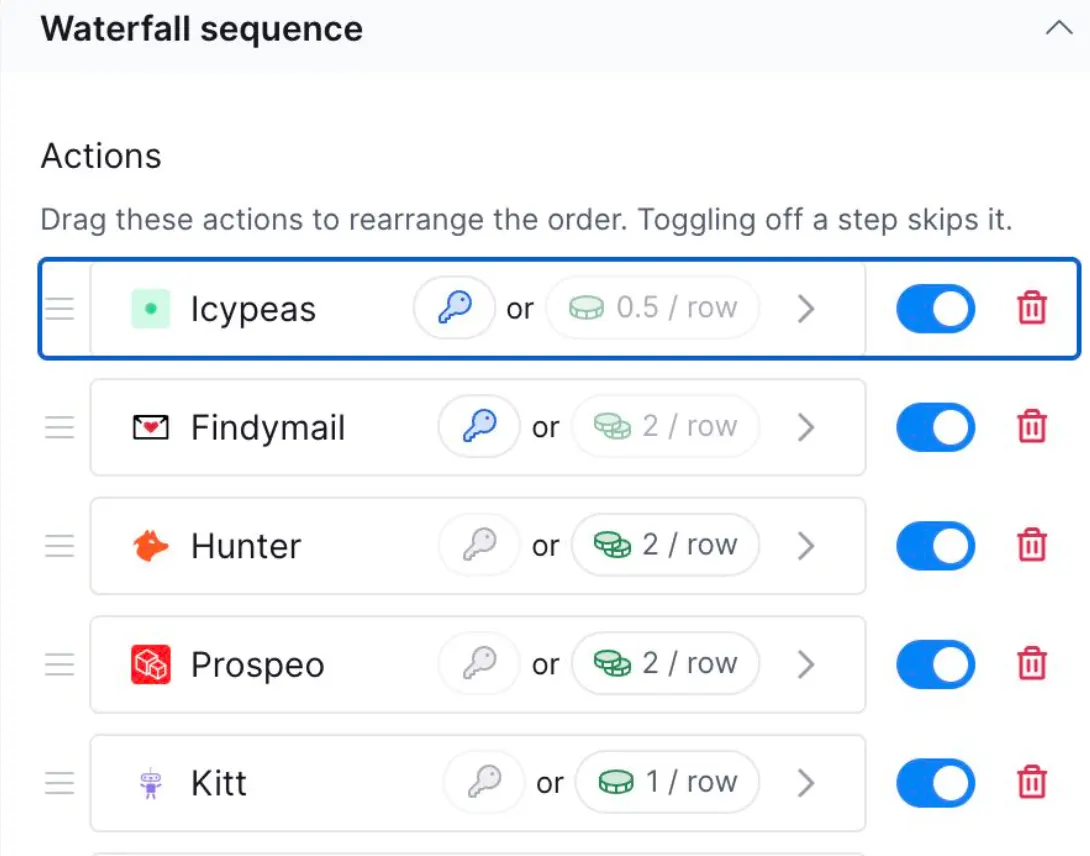
The logic is simple but powerful: find as many emails as possible with the cheapest provider first. Then use more expensive providers ONLY for the contacts that weren't found.
Our waterfall stack:
| Step | Provider | What It Does | Coverage |
|---|---|---|---|
| 1 | Icypeas | First pass - cheapest | 55-65% found |
| 2 | Findymail | Second pass on unfound | +15-20% found |
| 3 | Prospeo | Third pass on remaining | +5-10% found |
| 4 | ZeroBounce | Validation layer | Removes invalid + catch-all |
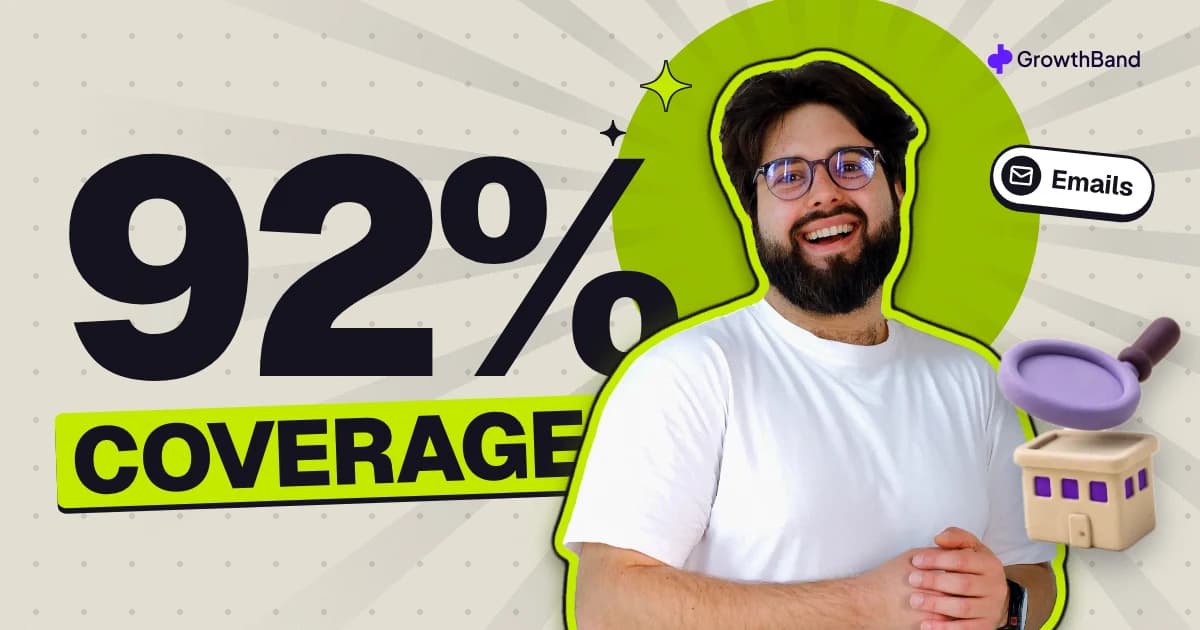
Final result: 92-93% email coverage. Less than 1% bounce rate.
Why This Matters More for IT Agencies Than You Think
Consider everything you've invested BEFORE the email finding step:
- Finding the right companies across multiple sources
- Running AI research to classify tiers
- Checking tech stack alignment
- Identifying buying signals
- Pulling decision maker data
All of that work is wasted if you can't reach the prospect. Losing 40% of your researched contacts to weak email finding is like building a sales pipeline and then randomly deleting almost half of it.
The waterfall approach ensures you capture maximum value from all the research you've already done.
The Complete Pipeline: From Signal to Send
Let's zoom out and see how all of this connects end to end.
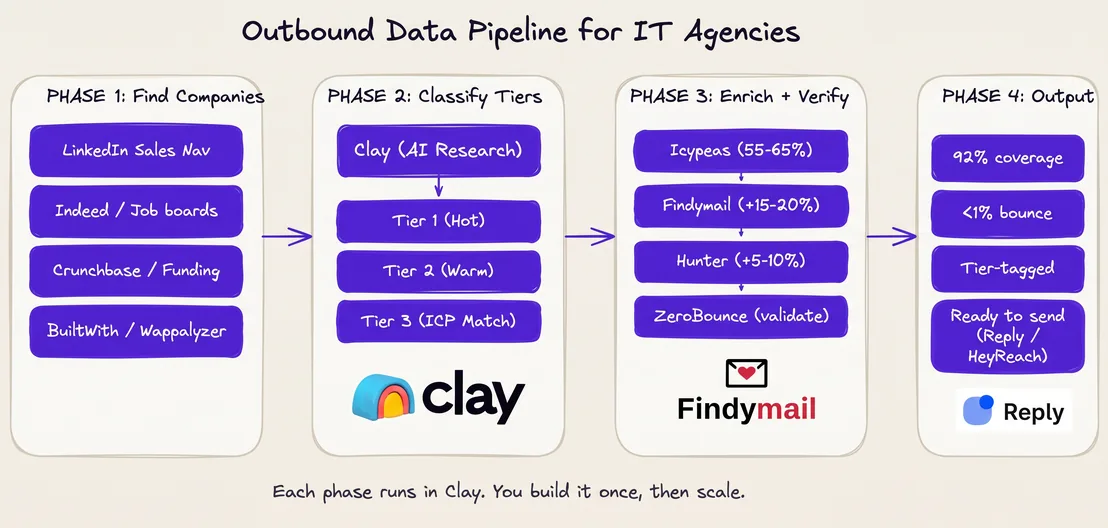
Phase 1: Find Companies
This is where you cast the net. You're pulling from multiple data sources because no single source gives you a complete picture.
Sources we use:
- LinkedIn Sales Navigator - company filters by size, industry, geography, growth rate
- Indeed / LinkedIn Jobs - companies actively hiring developers (your strongest Tier 1 signal)
- Crunchbase - recent funding rounds (budget signal)
- BuiltWith / Wappalyzer - companies using specific technologies you specialize in
Pro tip for IT agencies: Don't just search for "companies hiring developers." Search for companies hiring developers in the SPECIFIC technologies you offer. A company hiring Go developers when your team does React isn't your prospect. This level of specificity is what separates good lists from great ones.
All of these sources feed into a single Clay table where the magic happens.
Phase 2: Classify by Tier
This is where Clay's AI Research agents earn their keep.
For each company in your table, the agents:
- Check Indeed/LinkedIn for active developer job postings
- Cross-reference job posting technologies with your tech stack
- Look up funding history on Crunchbase
- Analyze when the key decision maker started their role
- Check headcount growth trajectory
- Scan for Eastern European developers already on the team
- Assign a Tier (1, 2, or 3) with the reasoning
The output: every company in your table now has a Tier tag, relevant context about WHY it's that tier, and the specific signals that were found. This context feeds directly into your copywriting.
Phase 3: Email Enrichment + Validation
Run the waterfall: Icypeas first, Findymail for unfound, Prospeo for remaining, ZeroBounce validation on everything.
The result: 92%+ of your contacts now have a verified, safe-to-send email address.
Phase 4: Ready to Send
Export to your sending platform - we typically use Reply or HeyReach.
Critical detail: each tier goes into its own sequence. Tier 1 prospects get hyper-personalized emails referencing their specific signals. Tier 2 gets relevant, context-aware emails. Tier 3 gets value-first emails with different angles being tested.
Never mix tiers in the same sequence. The whole point of the classification is to enable different approaches.
Infrastructure: The Foundation Nobody Wants to Talk About
I wasn't going to include this section because it's not as sexy as "signal-based prospecting." But here's the reality: none of the above matters if your emails go to spam.
We manage 15,000+ mailboxes. Here's the minimum you need to not waste your own time:
The Basics
Domains: Never send cold emails from your primary domain. Buy separate domains (variations of your brand). Rule of thumb: 1 domain per 3 mailboxes.
Mailboxes: Start with 20 minimum. Each mailbox sends 15 real cold emails per day (Google + Microsoft) to maintain a healthy sending-to-warmup ratio.
Volume math:
- 20 mailboxes x 15 emails/day x 22 working days = ~6,600 cold emails per month
- That's roughly 1,500-2,000 unique contacts per month (with follow-ups)
Warm-up: Minimum 14 days of warm-up before any cold sending. Use a reputable warm-up tool, not just "send emails to friends."
DNS: SPF, DKIM, and DMARC must be configured correctly on every sending domain. If you don't know what these are, this is not optional - it's the bare minimum for inbox placement.
Monitoring: Check deliverability weekly. If your emails start hitting spam, stop sending and fix the issue before it compounds. A damaged sender reputation takes weeks to recover.
The Reality Check
Infrastructure is the foundation everything else sits on. You can have the perfect Tier 1 prospect list, the best copy in the world, and verified emails - but if your messages land in spam, none of it matters.
This is also the part that's hardest to do well on your own. It requires ongoing monitoring, proactive fixes, and deep knowledge of how email providers (especially Google and Microsoft) evaluate sender reputation.
We included an Infrastructure Checklist in the Starter Pack below that covers the essentials. But if you want this handled for you, that's literally what we do - more on that in a future post.
Making It Work: Practical Tips From 350+ Campaigns
A few things we've learned the hard way that will save you time:
Start narrow, expand later
Don't try to target "all US tech companies" on your first campaign. Pick ONE vertical (fintech, healthtech, e-commerce, SaaS - whatever has worked best for you before), ONE company size range, and ONE buyer persona.
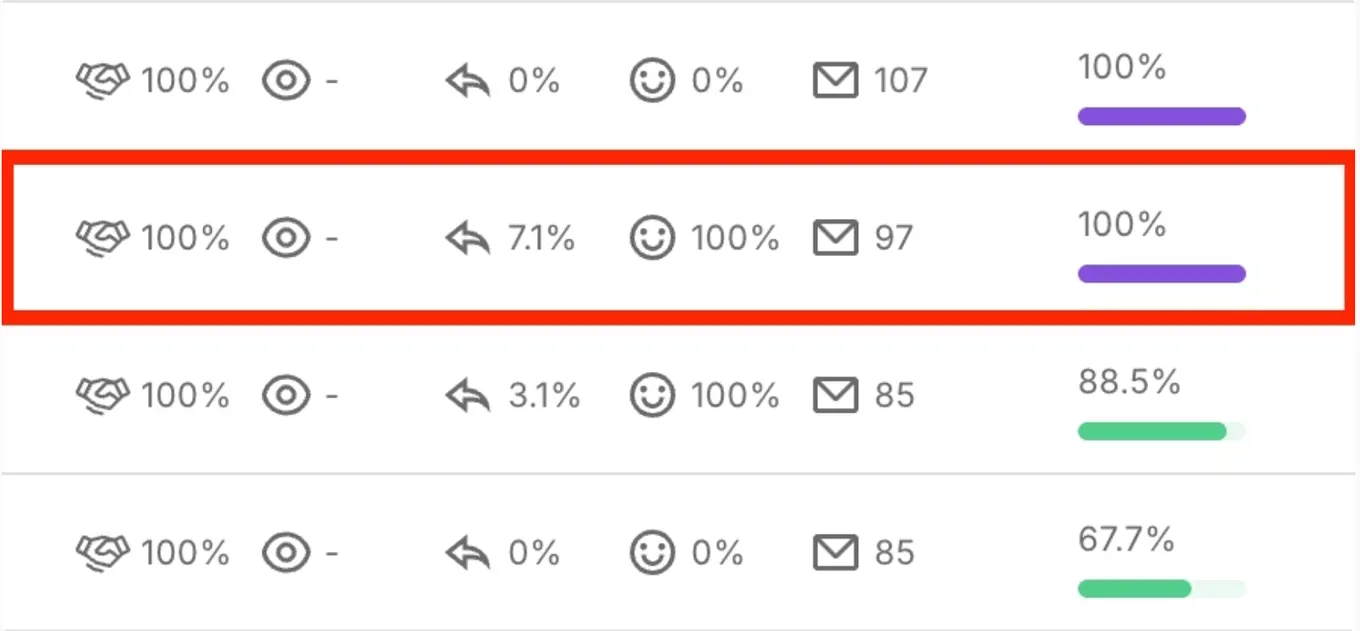
Run that for 2-4 weeks. Learn what works. Then expand.
The temptation to go wide from day one kills more outbound programs than bad copy does.
Test hypotheses, not subject lines
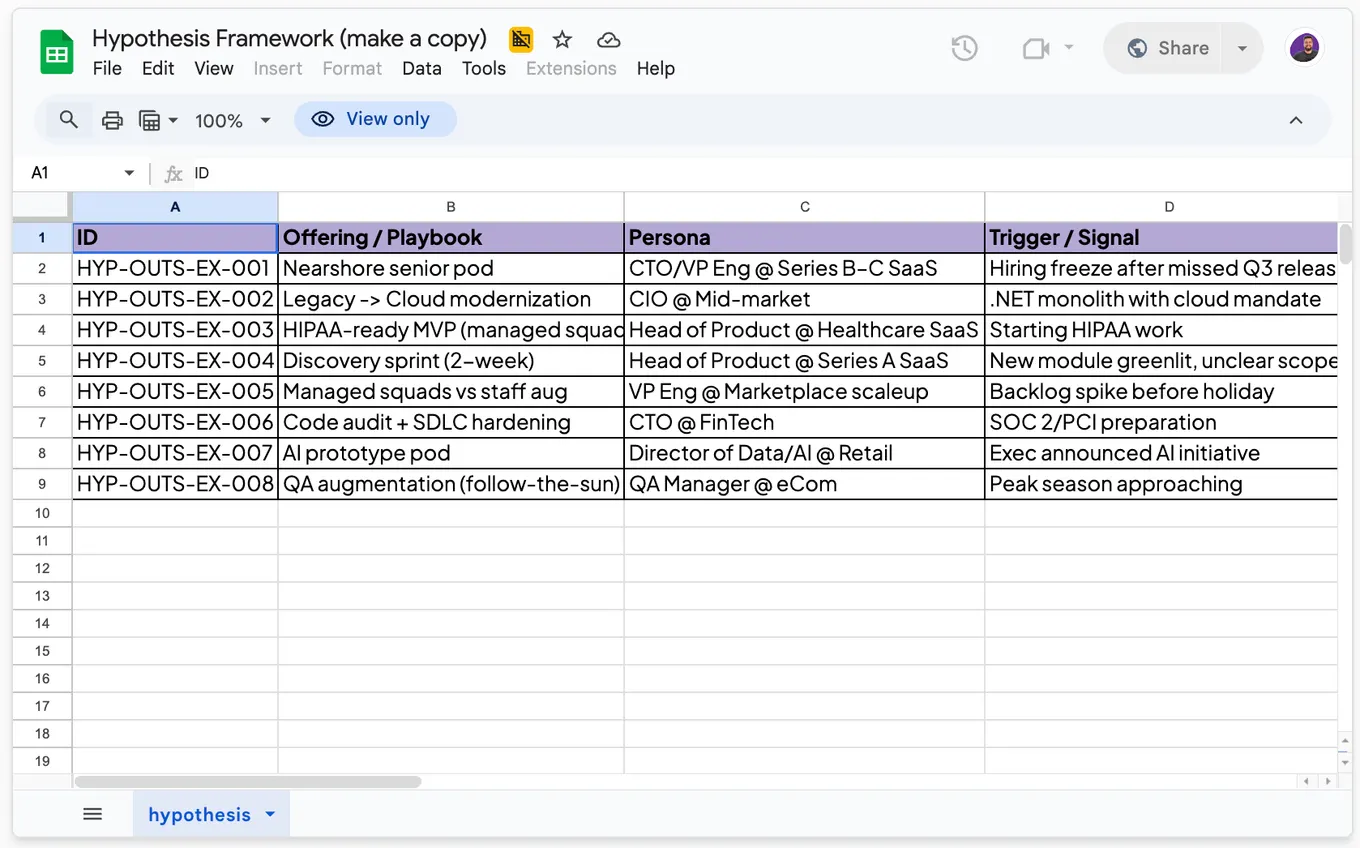
A/B testing subject lines is fine but it's the smallest lever you can pull.
Instead, think in terms of hypotheses:
- ICP hypothesis: "CTOs at Series A fintech companies who are hiring React developers will respond better than CTOs at Series B e-commerce companies"
- Offer hypothesis: "Staff augmentation framing will get more replies than dedicated team framing"
- Angle hypothesis: "Leading with speed-to-hire will outperform leading with cost savings"
Run each hypothesis for 2 weeks with enough volume to be statistically significant. Kill what doesn't work. Scale what does.
This is how you build a system that gets smarter over time instead of guessing forever.
Use your own sales calls for copy research
The best cold email copy doesn't come from copywriting frameworks. It comes from the language your actual clients use.
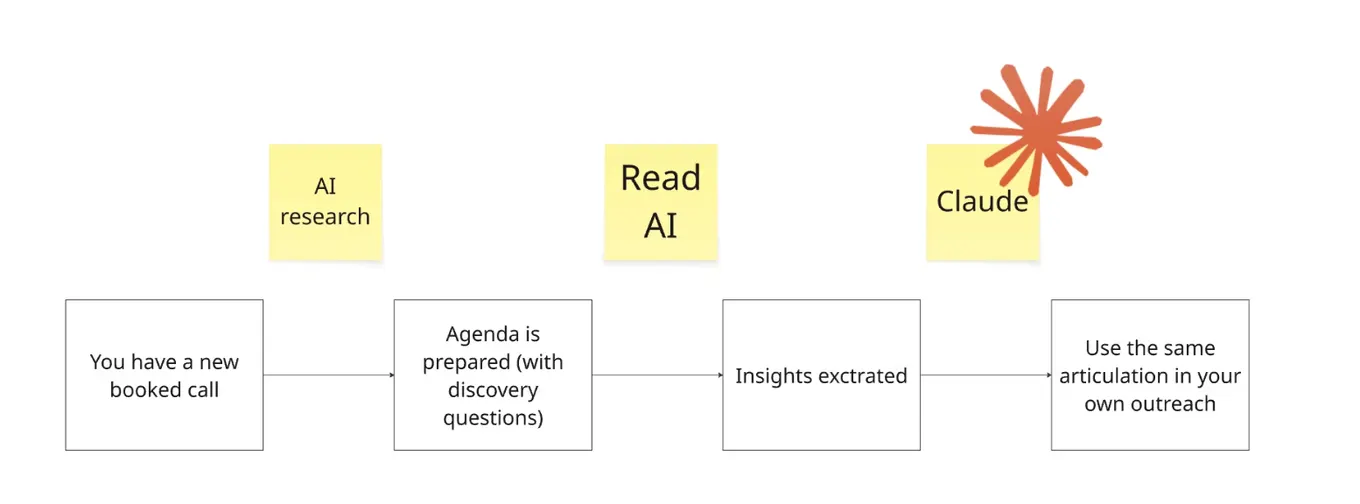
Record your sales calls and discovery calls. Listen for:
- How do clients describe their problem BEFORE they found you?
- What specific words do they use?
- What was the trigger that made them start looking?
- What did they try before that didn't work?
Take those exact phrases and put them in your cold emails. This is what we call the "Client Voice" method - and it's the single biggest unlock for copy quality we've found across 350+ teams.
When a CTO reads your email and thinks "that's exactly my situation" - it's because you're using language from someone who WAS in exactly that situation.
Don't underestimate Tier 3
Most teams want to focus only on Tier 1 because the reply rates are higher. That's understandable but short-sighted.

Tier 3 is 60-70% of your total addressable market. Even at a 1-3% reply rate, the volume means it generates significant pipeline. More importantly, it's where you test new angles, new offers, and new approaches - at scale, with real data.
The agencies that win at outbound long-term are the ones who treat Tier 3 as a systematic testing engine, not an afterthought.
What Makes This Different From "Just Use Apollo"
If you've read this far, you might be thinking: "This seems like a lot more work than just pulling a list and sending emails."
You're right. It is more work upfront. But here's why it pays off:
1. Signal-based targeting changes the math entirely. When you email 1,000 random CTOs, you're competing with 50 other agencies in their inbox. When you email 50 CTOs who posted 3 React developer jobs this week, you're the only one talking about their actual problem. It's not even the same game.
2. Tier segmentation makes specific copy possible. Generic copy exists because people send to generic lists. When every Tier 1 prospect has a known hiring signal, your email can reference it directly. That's not "personalization at scale" - it's genuine relevance.
3. The waterfall saves real money at scale. If you're enriching 2,000 contacts per month, the difference between $0.009/contact and $2/contact adds up fast. That's budget you can redirect into testing more angles or expanding your ICP.
4. You build it once, then iterate. The Clay pipeline doesn't need to be rebuilt each month. You refresh your data sources, the pipeline processes new companies through the same classification and enrichment logic, and you're sending within days - not weeks.
5. Hypothesis testing on Tier 3 feeds everything else. Your largest segment becomes your testing ground. The winning angles, CTAs, and offers from Tier 3 campaigns inform how you approach Tier 1 and 2. It's a system that gets smarter over time.
Outbound Reinvented for Your In-house Team
If you want help implementing this system - not just learning about it - here's what we do:
We deploy and manage the full outbound infrastructure for B2B teams.
You own the ICP, the copy, the pipeline.
We own the deliverability, the data, the execution control.
Done-with-you. Not done-for-you.
That's it. Go watch. Take notes. Implement.
Get the Full Starter Pack
This guide gives you the framework. The Starter Pack gives you the implementation details.
- Tiering System (how to prioritise your contacts to reach out to)
- Hypothesis Template (how to test your ideas with outbound)
- Full Cold Email Deliverability Guide
- Microsoft Deliverability Approach (99%+ Inbox Rate)
- Outbound Planner
- ICP template
🛠️ TOOLS WE USE & TRUST:
These are the exact tools we use with our clients:
→ Clay - data research & enrichment (this changed everything)
→ AI SDR by Reply - automated outreach at scale
→ Expandi or Heyreach - LinkedIn outreach (we used to run growth here)
→ ZeroBounce - email validation (keeps bounce rates <1%)
Talk to the team that runs this every day
Book a 30-minute call. We look at your outbound and tell you what we would change first.

Ilya AzovtsevCo-founder
Co-founder of GrowthBand. Helped scale lemlist from $20k MRR to $10M ARR and built automation at Expandi; now runs the cold email infrastructure behind 32,000+ mailboxes.