AI doesn't fix lead generation. It multiplies whatever you already do.
Point it at the wrong list, and you burn your market faster. Point it at a template, and ten thousand people get the same email, slightly reworded. Point it at a system, and it does in minutes what used to take my team days.
We run our own lead generation on AI agents: research, timing signals, copy, replies and a weekly loop that reads the results. Here is where AI earns its place and where it hurts.
Key takeaways
- AI lead generation is a pipeline: find who fits, find the timing, verify, write, answer, learn. AI helps at every step only when a check follows it.
- AI multiplies. On the wrong list, or with no learning loop, it automates failure at scale.
- The website decides who fits, not the database tag. In one of our own lists, part of the leads could never use the pitch.
- People reply for something about them: a strategy page about their business clearly beat a demo of our agents.
- Speed is where AI wins outright: a positive reply now starts an agent within minutes.
What AI lead generation actually is
AI lead generation means using AI models and agents to find the companies that fit, spot when they are likely to buy, write to each person, answer the replies and learn what works.
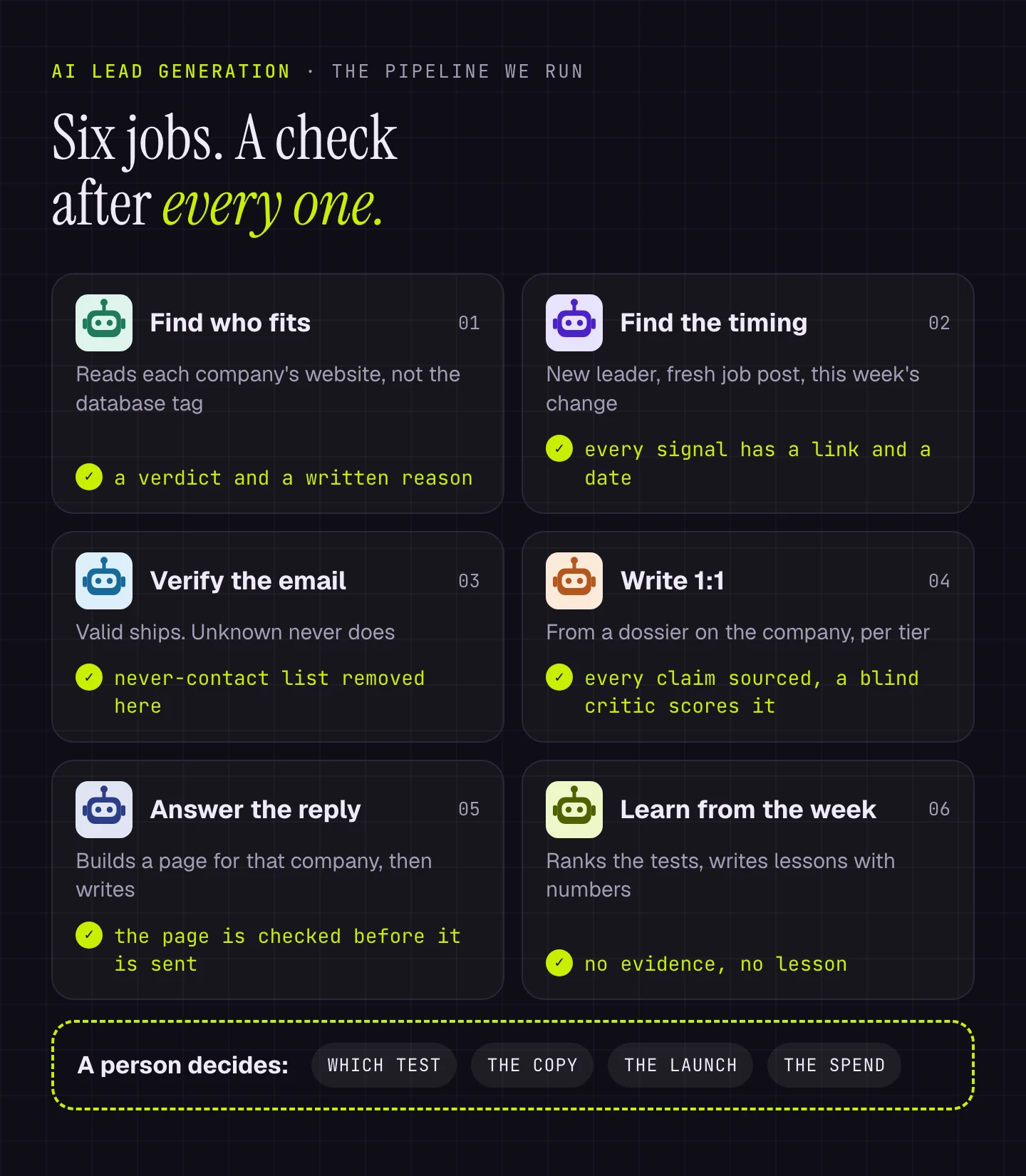
In practice it is six jobs:
- Find who fits. Read each company's website and decide if it does what your campaign is about.
- Find the timing. A new leader, a fresh job post, a change this week.
- Verify the email. Valid ships. Unknown never does.
- Write 1:1. From facts about that company, not from a template.
- Answer the reply. In minutes, with something built for that lead.
- Learn from the week. Read the results, keep what works, kill what doesn't.
Most AI tools, and most AI agents for lead generation, cover one of these jobs. Most failures happen between them, where nobody checks the handoff.
Why AI on the old playbook automates failure
The old playbook: buy a list by industry and size, write one template, send at volume, read replies when someone has time.
Add AI to that, and you get the same playbook, faster and bigger.
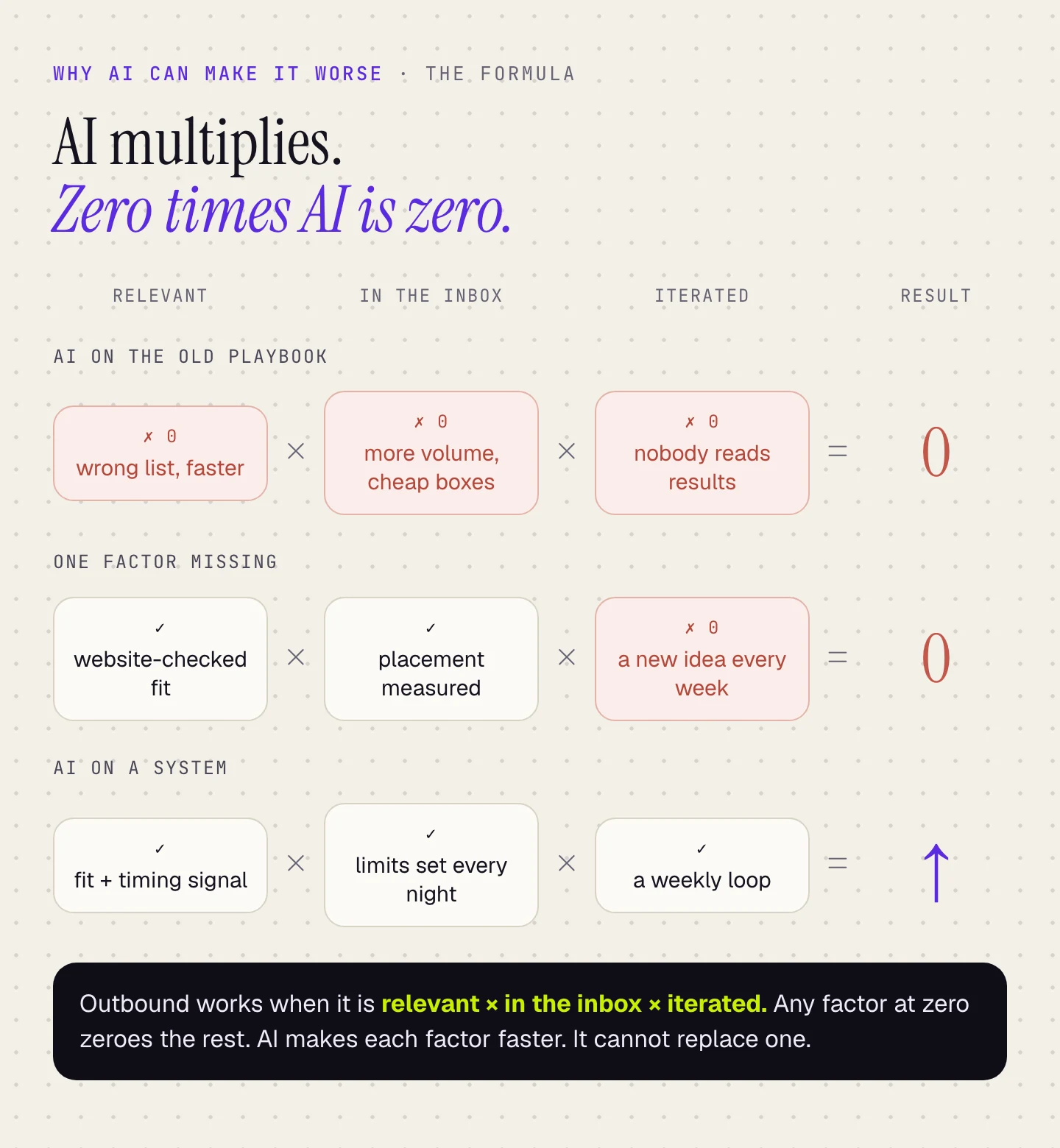
Outbound works when three things are true at once: the message is relevant, it lands in the inbox, and you keep iterating. That is multiplication, not addition. Any factor at zero zeroes the rest, and AI can't replace a missing factor. It only makes the others faster.
| Step | AI on the old playbook | AI on a system |
|---|---|---|
| The list | Industry and size from a database tag | Fit checked on each company's website, with a written reason |
| Who first | Everyone, the same week | Tiers by timing signal |
| Copy | One prompt, one email, reworded 10,000 times | 1:1 from a dossier, every claim checked |
| Sending | More volume from cheap mailboxes | A limit per mailbox, set every night |
| Replies | Answered when someone has time | Answered in minutes, with a page for that company |
| Learning | Nobody reads the results | A weekly agent writes lessons with evidence |
1. Find: the website decides who fits
Bad emails and people who left are small problems. Irrelevant companies are the big one: they burn the list and the sending domain at the same time.
On one of our own campaigns, part of the list had almost no sales team. The email pitched scaling a sales team. No copy could fix that. AI copy would only have sent the mistake faster.
Database industry labels often disagree with what a company actually does. So this is the first place AI earns its keep: reading every company's website, at list scale, and writing down a verdict with a reason.
Our researcher agent works from the same spec we give human list builders:
- Fit is checked on the company's own website. Not the industry tag.
- Exact values only. Company size is 84, not "51-200". Sales headcount is a number, and 0 is an answer.
- Hiring sales now is yes or no, with the role, the link and the date.
- Email verified, or it doesn't ship. Catch-all gets its own column.
- Never-contact is a field, not a note. Current clients, competitors and everyone who asked to stop are removed here.
2. Timing: tiers by signal, not by company size
Most lists are sorted by firmographics. Size, industry, location, title. That tells you someone fits a profile, not that they have the problem this month.
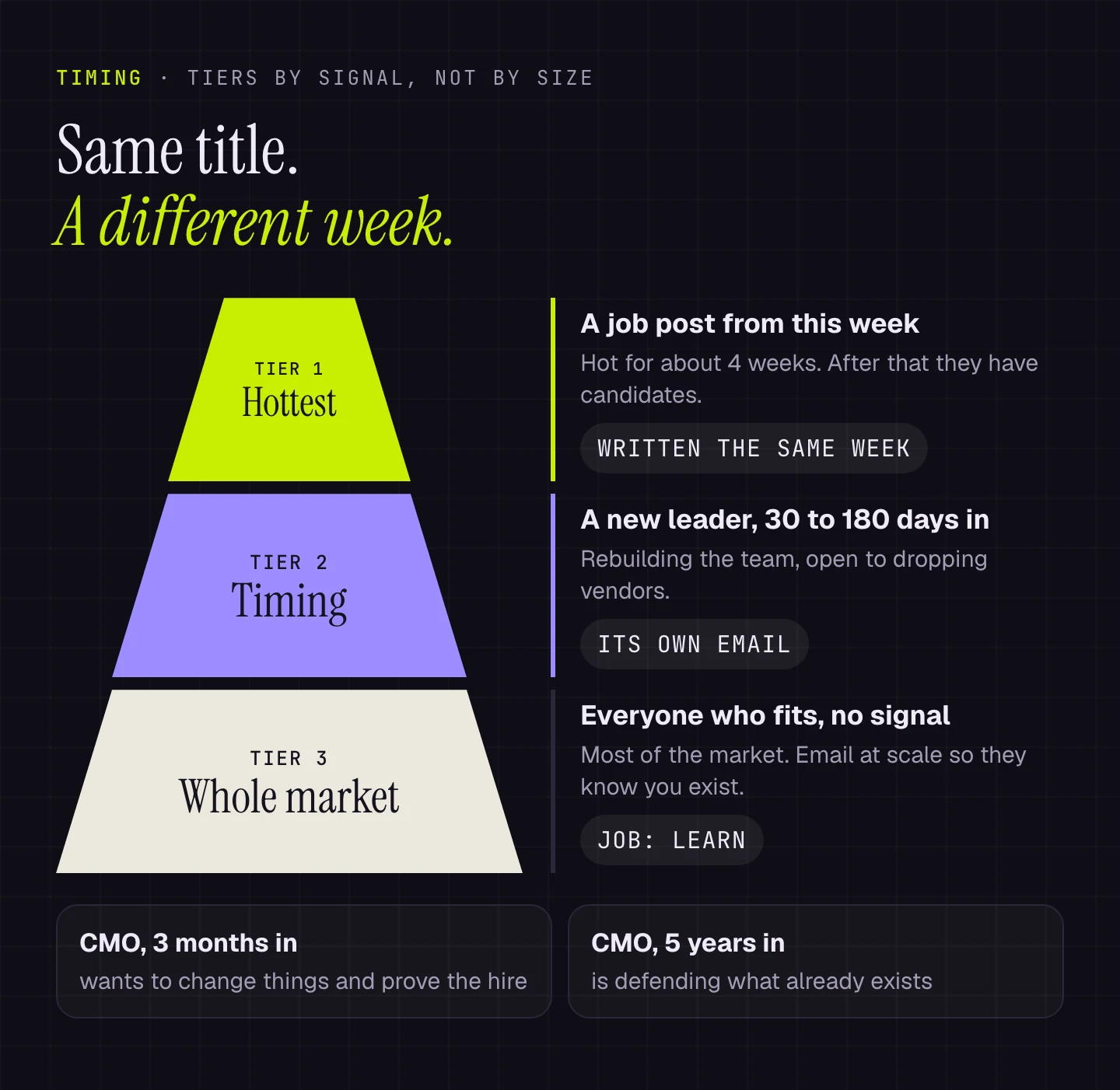
A CMO who joined three months ago wants to change things and prove the hire. A CMO of five years is defending what exists. Same title, opposite message.
Timing beats volume. So we split the market by timing, and each tier gets its own email:
- Tier 1, the hottest signal. A job post from this week. It stays hot for about four weeks; after that they have candidates.
- Tier 2, timing. A new leader, 30 to 180 days in the role, rebuilding the team.
- Tier 3, the whole market. Everyone who fits, with no signal. Email at scale, so they know you exist. The job of this tier is to learn.
AI's job here is the boring part: collecting the signals every week and checking that each one has a link and a date. A signal without a source is a guess.
The long version is in our tiering model and buyer signals for relevancy-first outreach.
3. Write: 1:1 from a dossier, not a template
Generic AI copy is the most common failure. One prompt, ten thousand contacts, and every email opens with "I noticed your company is growing". Readers spot the template in a line.
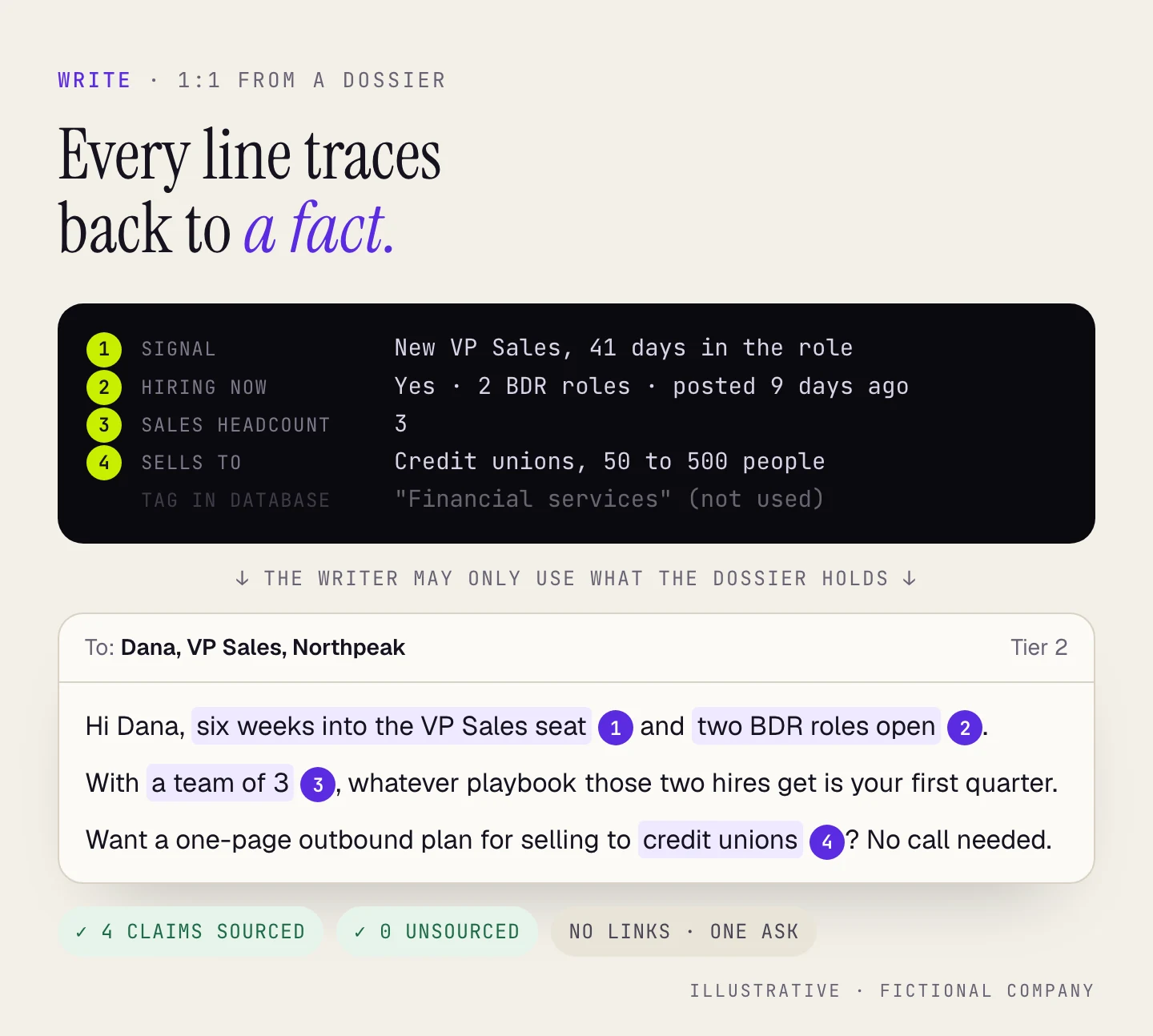
Our writer agent gets a dossier per company and may only use what it holds. Then separate agents check it:
- A claims audit. Every claim must trace to the dossier or to what we are allowed to say.
- A blind critic. It never sees the brief. It scores the email and quotes the weak phrase with its fix.
- A render check on real rows, so nobody gets "Hi s,".
- Then a person approves. The writer never grades itself.
The bigger lever is the offer, not the wording. We sent two offers to the same audience. One offered a one-page outbound strategy about the reader's own business. The other offered a demo of our agents. The strategy page clearly won.
People reply for something about them, not something about us.
4. Answer: replies in minutes, with something built for them
This is where AI wins outright. A positive reply goes cold in hours, and most teams answer when a founder has time.
We were no different before we switched.
And most replies don't need an answer at all: out of office, auto replies, not interested. Sorting them is easy work for AI. Answering the interested ones well is the part that matters.
A "yes" is cheap. On one of our campaigns, most positive replies were a bare "yes". What you send back decides what happens next. Once, a campaign of ours promised an audit and delivered none.
So the rule now is show, don't announce. If we can build it, we send it:
- A positive reply starts an agent within minutes. It reads the whole thread and looks up which offer that campaign made. It never guesses the offer from a campaign name.
- It builds first, then writes. A strategy page for that company: their market, who to write to, the first tests.
- It checks the page before it sends. Photo, logo, prices, no placeholders.
- A buying conversation goes to a person. An open deal, a legal question, a price to negotiate.
You can see what such a page looks like on our Agentic Outbound page.
5. Learn: the loop is what compounds
Without a loop, AI lead generation repeats the same mistake next month, at a larger volume.
In our own account, only the campaign families we kept iterating made real pipeline.
The loop is simple:
- One test is one segment, one signal, one angle. A few hundred contacts, about six working days, then a decision.
- A simple matrix. High reply and low interest: change the copy. Low reply and high interest: check deliverability. Low and low: kill it. High and high: scale it.
- A weekly agent reads the results. It ranks the tests and puts the decisions in a person's queue. It never changes a campaign itself.
- No evidence, no lesson. Every lesson names the campaign and the numbers.
One test cost us the most to learn: one type of mailbox brought almost no positive replies while another brought far more. That is a hard rule now. Another test is a warning about reading too early: after the first hour, a test of two P.S. lines looked like a clear win for one side. It wasn't.
Where AI helps and where it hurts
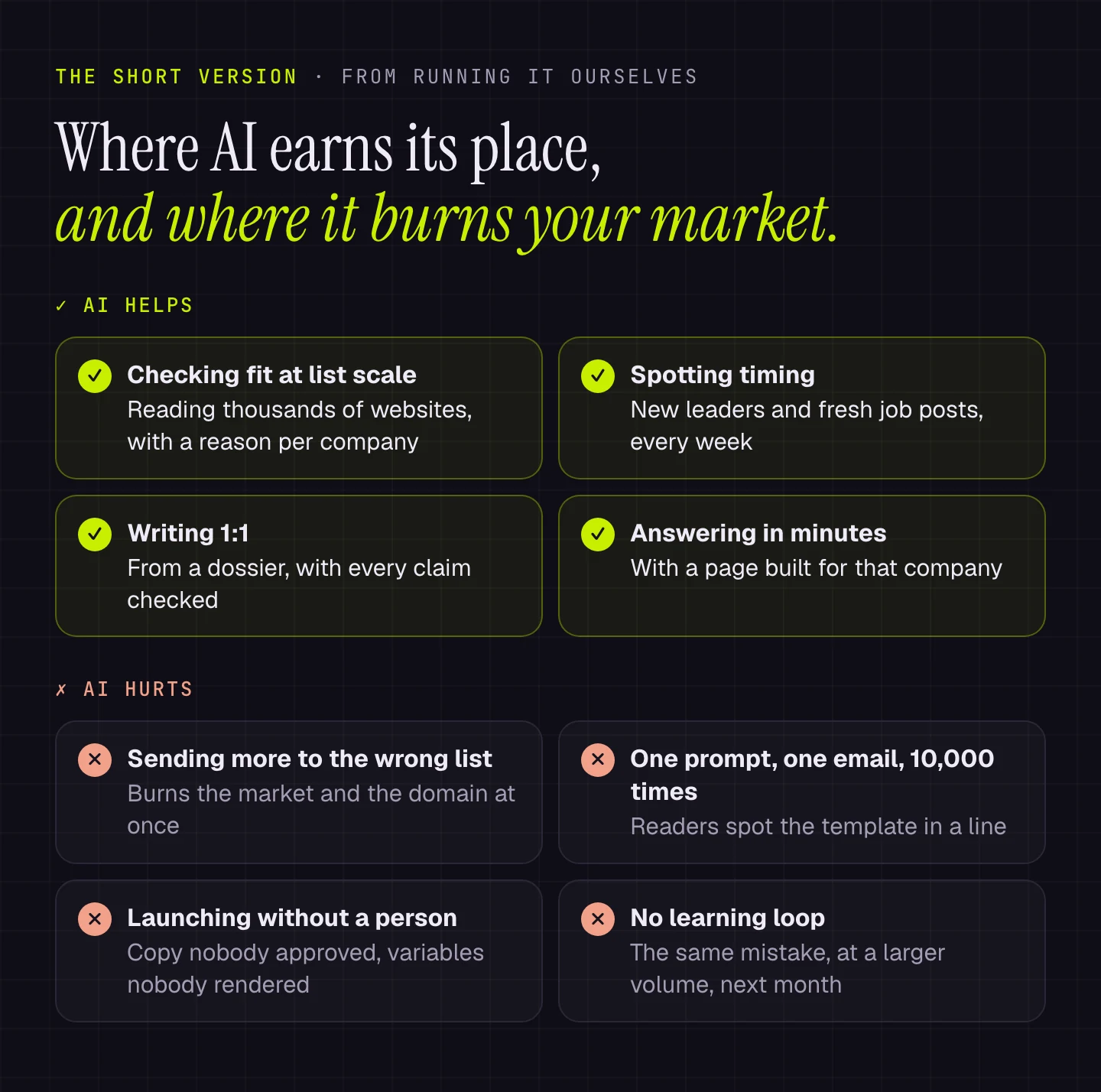
The pattern behind the grid: AI is great at work that is repetitive, needs reading at scale and has a clear check. It hurts when it gets volume without a check, or decisions without context.
AI prospecting tools: what you actually need
Every list of AI lead generation tools ranks products. I'd rather show you the categories, because each one breaks in its own way.
| Category | Its job | Check before you pick |
|---|---|---|
| Data | Companies, people, job posts, leadership changes | Exact values, not ranges. Every signal with a link and a date |
| Verification | Is this email real | Valid, catch-all and unknown kept apart. Unknown never ships |
| Sending | Mailboxes, schedules, daily limits | A limit per mailbox that can change every day, and placement you can measure |
| CRM | Deals, contacts, history | Never-contact as a field your agents can read, not a free-text note |
| Agents and models | Research, writing, replies, weekly analysis | Does it read your own context every time: ideal customer, past results, call notes? Or start from zero? |
Tool choice matters less than the loop. Every category has plenty of decent options. None of them knows your market. The results come from what you feed the tools, the check after each one, and whether anyone reads the results every week.
If you want to see how the agents, the shared memory and the checks fit together, read how agentic outbound works in our own team.
How to start
Start in this order. Each step pays off on its own:
- Write a list spec before you buy any data. Exact fields, exact values, who you never contact.
- Check fit on the website. Let AI read every site and write a verdict with a reason.
- Split the list by timing. Fresh signal, new leader, everyone else. One email per tier.
- Run one test at a time. One segment, one signal, one angle, a few hundred contacts.
- Answer positive replies the same hour, with something built for that company.
- Read the results every week and write each lesson down with its numbers.
The full Agentic Outbound Playbook covers all of it chapter by chapter, plus the recording where I run the whole system live. Get the playbook here →
Or run it with us. We build the system on your own data and run it next to your team for six weeks. The pilot is $2,000. In week six you decide on real replies and meeting quality. If it works, we continue, priced by volume. No auto-renewal.
Is AI lead generation worth it?
Yes, for the work a person can't do at scale: reading every company's website, watching timing signals every week, writing each email from facts and answering replies in minutes. It is not worth it on a list or an offer that doesn't work yet. AI only makes that fail faster.
Can AI replace SDRs?
AI replaces most SDR tasks: research, first drafts, sorting replies and answering the easy ones. It doesn't replace judgment. Which test runs next, which copy goes out, the sales call and the price stay with people.
What data does AI lead generation need?
A list spec with exact fields, each company's website, timing signals with links and dates, verified emails, and your own context: your ideal customer, past campaigns, call notes and what has already worked. Without your context, AI writes generic emails.
How fast can you see results from AI lead generation?
Nobody can promise a number upfront. One test needs a few hundred contacts and about six working days before you can decide. Plan on a few weeks of tests before you know which segment, signal and offer work in your market.
Put an outbound team of AI agents in your Slack
Strategy, research, copy and deliverability agents working on your company's context, built and run with you.

Ilya AzovtsevCo-founder
Co-founder of GrowthBand. Helped scale lemlist from $20k MRR to $10M ARR and built automation at Expandi; now runs the cold email infrastructure behind 35,000+ mailboxes.